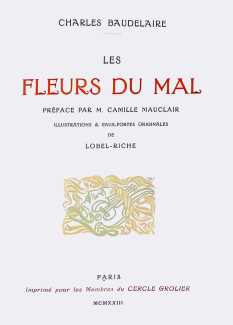
 Baudelaire’s Les fleurs du mal (The Flowers of Evil) was a text that Alméry Lobel-Riche related to unlike like any other. By the early 1920s Baudelaire had become a poet of personal significance to the artist, one whose preoccupations with desire, beauty and moral dilemma mirrored his own post-war introspection. This Cercle Grolier edition is the fullest expression of that long-standing identification.
The immediate post-war period was also a distinctive period in the history of Baudelaire illustration. Félicien Rops, whom Lobel-Riche had studied closely and acknowledged as a formative influence, had established the dominant visual idiom for Baudelaire through his work for Les épaves (The Fragments) – allegorical, satanic, death-haunted, the female figure rendered as symbol rather than person. Lobel-Riche’s approach is a deliberate counterstatement. His Baudelaire is a poet of erotic longing rather than transgression, and his women are not allegorical abstractions; they have solid physical presence and psychological weight. The devotional themes of the poems are shown through real-world characters, anchoring the texts in lived experience rather than symbolist mythology.
This makes the Grolier edition unusual and novel, as well as much more explicitly erotic. Where most illustrated Baudelaire invites the reader to contemplate the poetry from a position of ironic distance – the skull, the hourglass, the theatrical macabre – Lobel-Riche puts the reader right inside the poems’ emotional explorations. Just as his women are believable subjects of the poet’s attention, the male figure who appears repeatedly in the plates is an active participant, visibly undone.
The edition’s format deepens this reading. The remarques – the small subsidiary compositions etched into the margins below each main plate – are more than decorative additions; they are visible thinking around each subject – alternative approaches, distilled motifs, figures still in the process of finding resolution. They give the etchings added significance, as if the imagination of the artist was in motion even after the plate itself was finalised.
The surviving original drawings, several of which are included here, show the same quality at an earlier stage – the transition from working sketch to resolved colour composition is clear, and the spontaneity of early thoughts is preserved rather than smoothed away. Taken together, the finished plates and the preparatory drawings constitute an unusually full record of an artist reading verses of deep personal significance.
The Lobel-Riche illustrated Les fleurs du mal was published by Cercle Grolier, Paris, in a limited numbered edition of 224 copies; as well as the poems it included a new introduction by ‘Camille Mauclair’, the pen name of the poet and novelist Séverin Faust.