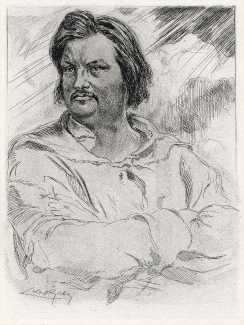
La fille aux yeux d’or (The Girl with the Golden Eyes) is an 1835 novella by the great French story-teller Honoré de Balzac. It is the final instalment of his History of the Thirteen (Histoire des treize), a trilogy which serves as an early and characteristically lurid component of his vast literary cycle La comédie humaine (The Human Comedy). Set in 1820s Paris, the History of the Thirteen follows a mysterious, all-powerful secret society of thirteen men who have pledged absolute loyalty to one another in order to manipulate French society from the shadows.
La fille aux yeux d’or follows the decadent heir Henri de Marsay, who becomes enamoured of the beautiful Paquita Valdès, she of the golden eyes, and plans to seduce her. Henri uses elaborate schemes to bypass her heavy security and find her secret boudoir in order to begin a passionate affair, but becomes disillusioned when he discovers she is involved with another lover, and so plots to murder her. When he arrives to kill her, he discovers that she is already dead by the hand of Euphémia Porrabéril, the Marquise de San-Réal. Porrabéril is a wealthy Spanish noblewoman who is both Paquita’s lover and her possessive guardian. In a shocking twist, she is revealed to be Henri de Marsay’s half-sister, as they share the same father, Lord Dudley.
Euphémia Porrabéril explains to Henri that Paquita came from a land where women are no more than chattels, able to be bought and used in any way. In the last lines of the story, de Marsay cold-heartedly tells a friend that the girl has died of ‘something to do with the chest’, by which he means tuberculosis, but has to live with the lie.
In La fille aux yeux d’or Balzac explores themes of lesbianism, bisexuality, androgyny, and power relationships, all highly controversial and ‘modern’ for the 1830s. It is these aspects of the work which made it daring at the time, and which give it a timeless significance.
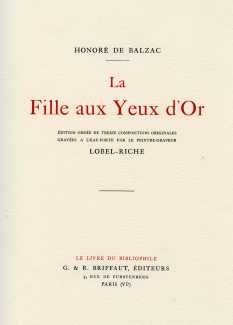 By 1923 Lobel-Riche was firmly established as one of Paris's pre-eminent illustrators of literary works with an erotic charge. His earlier suites for Baudelaire, Pierre Louÿs and Octave Mirbeau had already demonstrated the vigorous, heavily cross-hatched line, often enriched with drypoint, by which his mature style is instantly recognisable. La fille aux yeux d'or sits comfortably within that trajectory – fully canonical by the early twentieth century, its lesbian, androgynous and murderous content placed it among the more transgressive elements of the Comédie humaine, and thus the most likely to be entrusted to an illustrator of Lobel-Riche's calibre.
Lobel-Riche's approach to the novella is selective rather than systematic. The plates mark the points at which Balzac tips over into the erotic and the violent – de Marsay surveying the Tuileries promenade, the duenna keeping watch over Paquita, the lovers’ embrace in the boudoir, the bloody aftermath of the Marquise de San-Réal’s revenge.
For a 1920s readership, in which the lesbian salons of Natalie Barney and her circle were a visible feature of literary Paris, and the gender play of figures such as Romaine Brooks had become almost emblematic of the avant-garde, Balzac’s novella would have read very differently than it had in 1835. What had once been daring had become unmistakably modern, and Lobel-Riche illustrates the text with the confidence of an artist matched to his times.
La fille aux yeux d’or was published by G & R Briffaut, Paris, in a limited numbered edition of 500 copies.