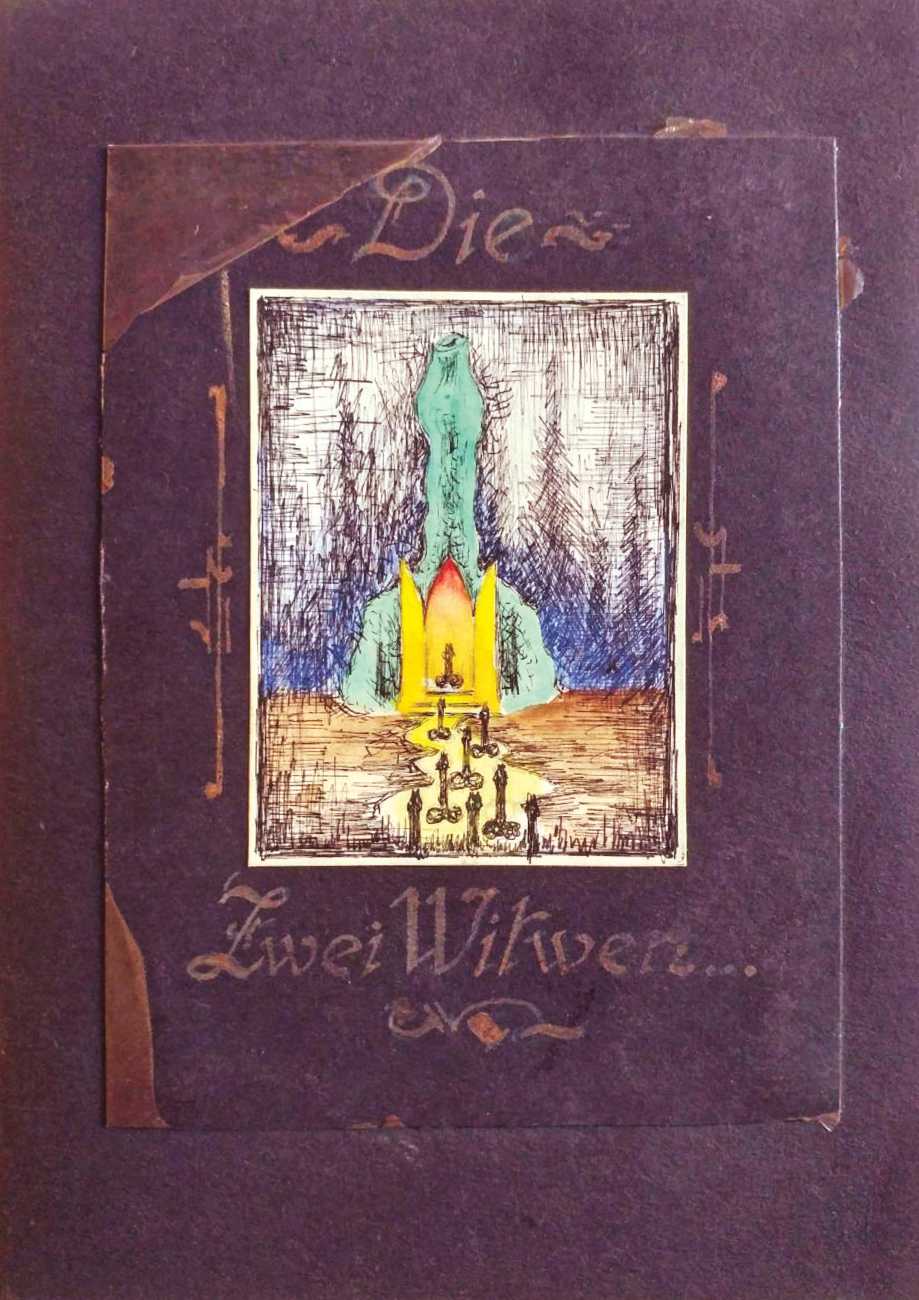
Die zwei Witwen (The Two Widows) is a unique handmade album of eight watercolours, a cover with a watercolour insert, and a pen-and-ink frontispiece, each plate mounted on dark brown card with brief manuscript captions on white labels, and dated Paris, 1928. The title-page gives the artist as Etienne de Básthy and bears the inscription Einzige Exemplar, the sole copy. Two widows, left without husbands, first console themselves by erecting churches to magnificent phalluses and worshipping a vast green tabernacle-idol. They kiss and embrace the statue, throw themselves wildly at the source of pleasure, and at last lick the final drop from its withering body. The widows collapse as snapping serpents, accusing each other of the death of their darlings, and in the heat of their grief and quarrel discover, with a kind of comic inevitability, new pleasures in each other's bodies.
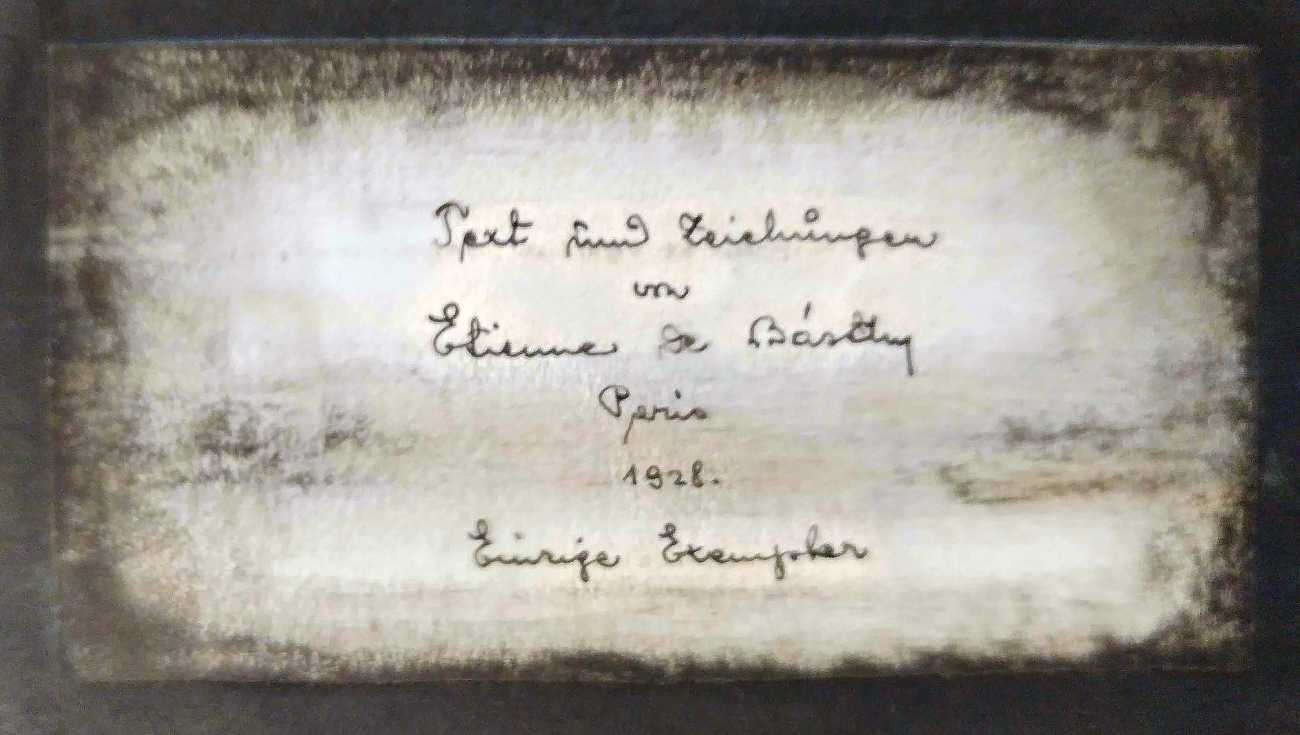
 Three features identify Básthy as the artist behind Die zwei Witwen. The first is the German itself, which is unmistakably non-native – einzige Exemplar should be einziges, and many of the captions show case errors, inverted word order, misformed prefixes (prächten, knapparte, schwarzenden), and idioms (in grösste Liebe harren, neuen Dings) consistent with a Hungarian current under the writer’s German. The second is the artist’s ‘French’ name. Étienne is the standard French rendering of the Hungarian István, the same translation chosen by, among others, the painter István (Étienne) Sandorfi a generation later, and the aristocratic de particle is a French flourish rather than a Hungarian one. The third, and decisive, detail is the acute accent on the á of Básthy. The diacritic is unambiguously Hungarian, and would not survive a fully Frenchified pseudonym.
 That a man with so visible a public career should have produced an erotic album in 1928 under a transparent French pseudonym is unsurprising in the European context of the period. Hungarian artists of his generation routinely maintained discreet sidelines in private erotic graphics, with the longer phallic and sensuous tradition of Mihály Zichy standing behind them, and artists including Marcel Vertès, Miklós Vadász and János Vaszary living and working in Paris during the 1920s.
The compositions are staged like proscenium scenes – a shallow stage of red ground, draped curtain-like surrounds, directional backlit auras around each figure, and a careful symmetrical framing which betrays the eye of a working scenographer rather than that of a draughtsman. The painterly handling of the watercolour, the heavy theatrical chiaroscuro, and the recurring tabernacle motif of the green phallic idol all sit comfortably within the symbolist inheritance of the late Habsburg generation through which Hungarian designers of Básthy’s generation had passed.
Here is the text of the album, in Básthy’s own German and in English translation.
Die zwei Witwen …
Text und Zeichnungen von Etienne de Bastly. Paris 1928. Einzige Exemplar.
Ohne Mann gebliebene zwei Witwen, die zusammen in grösste Liebe harrten … aber sie haben sich sehr nach zwei starken Männern gesehnt, die sie prächten. Sie den Kirchen von herrlichen Phallos auf … zu Hause umfangen küssten und herzten sie die Idole, ihre Geliebten … und mit Genuss sucht warfen sie sich wild auf den Quelle des Genusses … den letzten Tropfen haben sie auch ausgeleckt und ausgepressen von dem verwelkenden Körper… welche von den zwei traurigen Witwen durch ihren schwarzenden Traurigkeit und ungebändigten Kampf als knapparte Schlangen herunter fielen … die Freundinnen beschuldigten sich gegenseitig für den Tod ihrer Lieblingen und zerzankten sich unmenschlich… in der grossen Kampf sich neuen Dings erregend haben sie neue Freuden gefunden in der Körper von einander. Und das Geniessen hat ihre Fortsetzung gefunden …
The Two Widows …
Text and drawings by Etienne de Básthy. Paris 1928. Sole copy.
Two widows, left without husbands, languished together in the greatest longing … but they yearned so deeply for two strong men to adore them that they raised up churches to magnificent phalluses … at home they embraced, kissed and caressed the idols, their beloveds … and, craving pleasure, they threw themselves wildly upon its very source … they licked and pressed the last drop from the withering body … which then, through the two sad widows’ dark grief and unbridled struggle, fell down from them like snapping serpents … the two friends accused each other of the death of their darlings, and quarrelled inhumanly … and in the great struggle, arousing themselves anew, they found fresh joys in each other’s bodies. And so the pleasure continued …