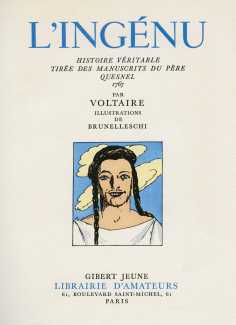
 ‘Ingénu’ is French for ‘ingenuous’ or ‘artless’, so Voltaire’s 1767 satirical novella L’ingénu, about a young American native who knows nothing of the intricacies of French culture, has been translated into English under various titles including The Sincere Huron, Pupil of Nature and Master Simple. It tells the story of a Huron called ‘Child of Nature’ who, after having sailed the Atlantic to England, crosses to Brittany in the 1690s and is assumed to be French.
Having grown up outside European culture, he sees the world in a literal, ‘natural’ way, causing him to interpret things directly rather than what is customary, which leads to comic misinterpretations. After reading the Bible, he feels he should be circumcised and calls upon a surgeon to perform the operation, which is stopped through the intervention of his adopted family. After his first confession, he tries to force the priest to confess as well. Not expecting to be baptised in a church, the villagers find Child of Nature waiting in a stream, as baptisms are depicted in the Bible.
The story satirises religious doctrine, government corruption, and the folly and injustices of French society. It also criticises contemporary corruption in the French government. Child of Nature, on his way to receive accolades for helping fight off a British seaborne assault, is wrongly imprisoned as a Jansenist after showing sympathy to the plight of those fleeing religious persecution. He spends a great deal of time in prison, until his lover – having been sent to a convent for four years – journeys to Versailles to discover his plight. To secure her lover’s release, she must succumb to the advances of a government minister. She seeks guidance from the confessor, but he says she must have misunderstood the minister’s deal, and that whatever he was suggesting must be for the best given that he is related to the king’s confessor. She eventually gives in for the sake of Child of Nature, but dies of an illness shortly after they are reunited.
Brunelleschi’s technique for these plates is distinctive, a lithographic foundation finished by stencil rather than the pure pochoir of his interwar work, resulting in softer, more granular textures beneath the highlights of citron yellow, hot pink, emerald and turquoise. The characteristic Brunelleschi repertoire remains – porcelain-doll faces with downcast eyes, mannered hands, obsessive costume detail. He was still a costume designer as much as an illustrator.
The narrative treatment is faithful but reveals his priorities. He devotes two plates to the Huron prelude – a very modern bathing-costumed beach scene and a noble savage figure. He devotes four plates to the Saint-Pouange seduction plot, while the Bastille plate, with its spectral nude apparition and the gaoler’s face at the barred window, is a small masterpiece of erotic melancholy.
The volume is typical of the Gibert Jeune Librairie d’Amateurs programme of the late 1940s, which issued French classics – Voltaire, Prévost, Laclos, Louÿs, Boccaccio – illustrated by surviving veteran artists including Brunelleschi, Bécat, Schem, Berthommé Saint-André and Grau Sala. These productions continued despite postwar austerity (the plates in L’ingénu are not good quality – we have enhanced them), though L'Ingénu is among the better of these late efforts, superior to the rather tired Manon Lescaut that Brunelleschi illustrated for the same publisher, and given his death the following spring it has additional poignancy as his closing statement.
The Brunelleschi-illustrated L’ingénu was published by Gibert Jeune in a limited numbered edition of 3,000 copies.