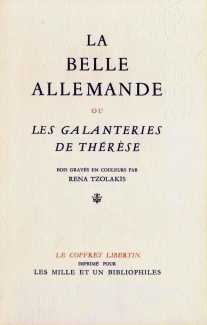
 The prolific French writer Antoine Bret (1717–92) is best known as a playwright, but he also wrote half a dozen novels featuring adventurous young women exploring their place in the world, sometimes with a classical background and sometimes closer to home. Such a theme is that of his 1745 narrative, originally titled La belle Allemande, ou les galanteries de Thérèse (The Beautiful German Girl, or the Gallantries of Thérèse), later better known as La belle Alsacienne, ou telle mère telle fille (The Beautiful Alsace Girl, or Like Mother Like Daughter).
It is not, however, the novel’s morality which lifts it. Thérèse does not pretend to have a deep philosophy, but she does know how to handle tricky and colourful situations, and is always on hand with wisely practical reflections. Mostly she recommends herself by having a good heart, an understanding of the kindnesses which facilitate life, and more particularly through the respect she demonstrates. These qualities are enough to make the reading of these short memoirs endearing, recounting the development of a young woman who devotes herself to giving pleasure without sparing either her body or her heart.
For this edition of Bret’s La belle Allemande Tzolakis worked in colour wood engraving on end-grain blocks, a technically demanding choice, taking the reader through a sequence of recognisably rococo episodes – a half-undressed bust portrait against a sage green ground, a young woman lifting her skirt at a gothic doorway with her lover loitering behind, a toilette scene with a maid combing out the hair of her seated mistress, an alfresco embrace observed by a woman in pink, a curtained bedchamber with the duenna drawing aside the drape, an intimate interior with the lover bending over the seated nude, a partie fine with four men crowded around their favourite at the supper table, and a final tender post-coital pairing in front of a brick-red wash.
The figures are confidently drawn, with pert chins, dark almond eyes, and lacquered hair piled into towering eighteenth-century structures, while the rooms, archways, draperies, brickwork and stone steps around the figures are worked in dense hatching, the visible grain functioning as tonal structure. Over this Tzolakis lays flat, slightly chalky colour – pinks, sage greens, teals, brick reds, ochres, printed rather than hand-applied so that the plates retain the matte surface and slight registration drift of true colour wood engraving. The result is a witty reanimation of the rococo libertine tradition that takes the genre seriously without taking the novel too solemnly. La belle Allemande is essentially a frivolous book about female pleasure and male credulity, and Tzolakis’s plates supply exactly the right tone, creating one of the last serious erotic livres d’artiste in the long French rococo-libertine tradition.
La belle Allemande was published in the Coffret Libertin series by Arts, Lettres et Techniques, in a limited numbered edition of 1,001 copies.