 Alfred de Musset’s 1836 La confession d’un enfant du siècle (The Confession of a Child of the Century) is a semi-autobiographical novel in which the narrator, Octave, looks back on the love affair that destroyed his youth and tries to understand how it happened. Written only two years after Alfred de Musset’s disastrous relationship with George Sand, the book is unmistakably shaped by that experience, though it stops short of being a direct roman à clef. Musset and Sand had met in 1833, travelled together to Venice, and separated amid illness, jealousy, infidelity, and the involvement of Sand’s Venetian doctor, Pagello. Both later offered competing literary versions of the affair, but Musset was first: La confession is his attempt to transform personal catastrophe into something broader and more historical.
The novel opens with one of the defining statements of French romanticism. Musset argues that the generation raised in the aftermath of the Napoleonic Wars suffered from a profound spiritual disillusionment. Napoleon had filled Europe with dreams of glory and possibility, only for those hopes to collapse after Waterloo. The young men who came of age afterwards, Musset suggests, were left directionless, too late for heroism, unable to believe in the future, oscillating between cynicism and desperate idealism. This condition he famously calls le mal du siècle, the sickness of the age.
Against this historical background unfolds Octave’s personal story. After discovering his mistress’s infidelity, he descends into dissipation and emotional distrust. During a period of recovery in the provinces he meets Brigitte Pierson, an older widow whose steadiness and goodness offer the possibility of happiness. They fall deeply in love, but Octave’s pathological jealousy gradually destroys the relationship. What gives the novel much of its power is its refusal to excuse him: Octave understands perfectly well that he is ruining the thing he most values, yet cannot stop himself. Eventually he sacrifices the relationship altogether, convincing himself that Brigitte can only be free once she is free of him.
Part psychological novel, part romantic manifesto, and part public reckoning with the Sand affair, the book remains most famous for its historical prelude, whose diagnosis of post-Napoleonic disillusionment became one of the central formulations of nineteenth-century melancholy.
Régis Manset’s colour lithographs are constructed from rapid pen-lines, crayon shading and flat colour washes, often dominated by a single tint. The result is closer to a fashion plate or wash drawing in the manner of Constantin Guys than to the heavily finished narrative illustration of the nineteenth century. His elongated figures, elegant silhouettes, and lightly handled 1830s costume detail reflect the style he developed through commercial work for houses such as Hermès, Schiaparelli, and Air France. Within the tradition of the French livre illustré, his closest parallels are perhaps Jacques Touchet and André Dignimont, who shared his preference for abbreviated, almost reportorial drawing.
Manset’s muted palettes – chalky greys, dusty mauves, lemon yellows – closely match the novel’s emotional atmosphere. Crowded Parisian interiors convey jealousy, dissipation, and emotional estrangement, while the quieter provincial scenes briefly suggest the possibility of happiness before Octave’s self-destructive impulses reassert themselves.
To give an idea of the flavour of the book, here is its most famous passage, in the original French and in English translation.
Pour écrire l’histoire de sa vie, il faut d’abord avoir vécu ; aussi n’est-ce pas la mienne que j’écris. Ayant été atteint, jeune encore, d’une maladie morale abominable, je raconte ce qui m’est arrivé pendant trois ans. Si j’avais été seul à souffrir, je n’en dirais rien ; mais comme il y en a beaucoup d’autres qui souffrent du même mal, j’écris pour ceux-là, sans trop savoir si je les intéresserai, mais espérant qu’ils me liront et que l’un d’eux au moins dira : «Voilà qui est vrai.»
Pendant les guerres de l’Empire, tandis que les maris et les frères étaient en Allemagne, les mères inquiètes avaient mis au monde une génération ardente, pâle, nerveuse. Conçus entre deux batailles, élevés dans les collèges au roulement des tambours, des milliers d’enfants se regardaient entre eux d’un œil sombre, en essayant leurs muscles chétifs. De temps en temps leurs pères ensanglantés apparaissaient, les soulevaient sur leurs poitrines chamarrées d’or, puis les reposaient à terre et remontaient à cheval.
Un seul homme était en vie alors en Europe ; le reste des êtres tâchait de se remplir les poumons de l’air qu’il avait respiré. Chaque année la France faisait présent à cet homme de trois cent mille jeunes gens ; c’était l’impôt rendu à César, et, sans ce troupeau qu’on lui menait chaque année, il ne pouvait accomplir son destin, ni se repaitre de l’océan du sang humain. Il était devenu l’âme du monde, et les étoiles demandaient à Dieu si elles devaient continuer de tourner.
To write the history of one’s life, one must first have lived, and it is not my own life that I am writing. Having been struck while still young by a terrible moral sickness, I recount what happened to me over three years. Had I suffered alone, I would say nothing of it, but since there are many others who suffer from the same affliction I write for them, without knowing quite whether I shall interest them, but hoping they will read me, and that at least one of them will say ‘Yes, that is true.’
During the wars of the Empire, while husbands and brothers were in Germany, anxious mothers brought into the world a generation that was ardent, pale, and strung with nerves. Conceived between two battles, raised in the schools to the rolling of drums, thousands of children looked at one another with sombre eyes, testing their feeble muscles. From time to time their blood-stained fathers would appear, lift them onto their gold-braided chests, then set them back on the ground and ride away.
One man alone was alive in Europe then; the rest of its inhabitants tried to fill their lungs with the air he had breathed. Each year France made a gift to this man of three hundred thousand young lives – it was the tax rendered unto Caesar, and without this flock driven to him annually he could not fulfil his destiny, nor glut himself on the ocean of human blood. He had become the soul of the world, and the stars asked of God whether they should continue to turn.
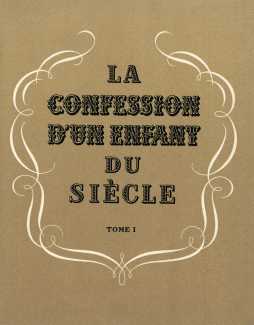
La confession d’un enfant du siècle was published by Éditions du Belvédère, in two volumes, in a limited, numbered and boxed edition of 800 copies.