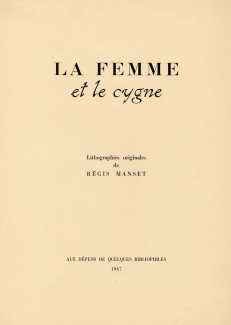
 The myth of Leda and the swan – Zeus disguising himself as a bird to possess the Spartan queen, with Helen of Troy among the offspring of the union – has attracted erotic illustrators in every period, not least because it presents the artist with a challenge that is simultaneously iconographic and evasive. The encounter resists the conventions of human union and demands instead a kind of transformation, a blurring of categories, which allows the erotic charge to operate at one remove from literal depiction. The tradition runs from the lost paintings of Leonardo and Michelangelo through Boucher and beyond, and by the twentieth century the subject had become something of a touchstone for the illustrated livre de luxe in its more adventurous forays. Régis Manset’s La femme et le cygne (The Woman and the Swan), published in the immediate aftermath of the German occupation, belongs to a specific moment in that history – liberation had reopened both the possibility of erotic publishing and the appetite for it, and this fine-press edition with its gentle lithographs and verses by an unidentified poet writing in a very convincing late-Parnassian libertine style was exactly the vehicle through which that appetite expressed itself most discreetly. The choice of the Leda subject suggested an artist with a classical frame of reference, conscious of handling a theme with a long pictorial genealogy.
The same hand is at work here as in the Confession plates of two years earlier, though the idiom is markedly softer and more lyrical. Manset employs the same colour-lithographic method – confident pen line, crayon shadow and broad watery washes – but here the line becomes almost calligraphic, especially in the swan’s plumage, where a few strokes suggest an entire wing. The tightly restricted palette of blue-greys, greens, flesh pinks and ochres creates a damp, pastoral atmosphere far removed from the harsher tonal contrasts of the Confession suite. Manset’s commercial manner gives way to something closer to the lyrical nude lithographs of Suzanne Ballivet, Mariette Lydis, and late Jules Pascin, artists who similarly dissolve the body into the medium itself.
The plates form a coherent narrative sequence. Leda first appears reclining beside the river while satyrs watch from the trees; the swan then enters alone in a moment of decorative stillness. Three subsequent plates treat the union through interwoven contours and increasingly abstracted forms rather than explicit anatomy. The closing images withdraw into mythic symbolism: an egg among cattails, and a tailpiece transforming rippling water into a signature-like flourish. Throughout, Manset avoids explicit eroticism, conveying sensuality instead through pictorial ambiguity and remarkable delicacy.
Here are the opening verses of the accompanying text, in the original French and in English translation:
Belle et se croyant seule, elle s’est mise nue.
Voluptueusement elle mire au flot clair
Les blés de ses cheveux et les lis de sa chair
Et les roses boutons de sa gorge menue.
Mais l’ondin lui décoche un regard saugrenu
Sous le blanc nénufar et sous le capillaire
Un zéphir énervé la caresse et la flaire
Et dans l'ombre tapi, maint satyre cornu
Semble prêt à bondir sur sa croupe élastique.
Que de pièges sournois dans ce monde érotique!
Et comment, ô Léda, te garantirais-tu
Contre le rut énorme et contre le mystère
Des déités de l'air, de l'onde et de la terre
Dont les désirs fougueux assiègent ta vertu?
Beautiful and believing herself alone, she stood naked.
With languid pleasure she admires in the clear stream
The wheat-gold of her hair, the lily of her skin,
The rosebud breasts upon her slender chest.
Yet the water-sprite beneath the white water-lily
And trailing fern, shoots her a furtive glance;
A fevered zephyr strokes her, scents her body,
And in the lurking shade more than one hornèd satyr
Seems ready to spring upon her supple haunches.
What sly entanglements haunt this erotic world!
And how, O Leda, could you ever guard yourself
Against the monstrous rutting urge, against the mystery
Of the deities of air and wave and earth
Whose burning desires besiege your chastity?
La femme et le cygne was published ‘Aux dépens de quelques bibliophiles’ (at the expense of a few bibliophiles) in a limited numbered edition of 300 copies.