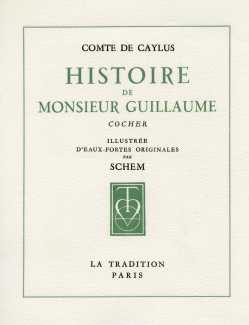
 Anne-Claude-Philippe de Tubières-Grimoard de Pestels de Lévis, comte de Caylus (1692–1765), is one of the foundational figures of eighteenth-century French antiquarianism, the author of the Recueil d'antiquités égyptiennes, étrusques, grecques, romaines et gauloises (Collection of Egyptian, Etruscan, Greek, Roman and Gallic Antiquities, 1752–1755), a member of the Académie Royale de Peinture et de Sculpture from 1731 and of the Académie des Inscriptions from 1742, and a connoisseur whose collecting and engraving habits placed him at the centre of Parisian artistic life. He was also a leading member of the Société du Bout du Banc, the literary circle organised around Mlle Quinault that included Crébillon fils, Voisenon and Fougeret de Monbron, the milieu in which much of his lighter work was conceived, polished and circulated. Caylus had, however, what his early biographers called ‘another side’, a thorough acquaintance with the more disreputable corners of the city, which resulted in a body of witty stories eventually gathered as the Œuvres badines complètes (Complete Bawdy Works, 1787).
Histoire de M. Guillaume, cocher (The Story of M. Guillaume, Coachman) is the best regarded of these lighter works. The dating is, characteristically for clandestine eighteenth-century curiosa, quite slippery – 1730, 1737 and 1740 are all suggested, and the text seems to have moved between manuscript and print before settling into the Œuvres badines of 1757. Caylus and his Bout-du-Banc associates were trading stories of low Parisian life through the 1740s, just before their younger friend Jean-Joseph Vadé crystallised the genre, and Guillaume is generally treated as one of the founding monuments of that idiom, tales in which the words of working-class Parisians can be heard.
The narrative is told in the first person by Guillaume, a retired coachman turned modest bourgeois on the outskirts of Paris, who takes up the pen to recount what he has seen from the box. In a tone of cultivated false naïveté, he strings together four amorous episodes the trade put in his way – the misadventures of one mademoiselle Godiche, two further intrigues observed in service, and finally the affair of a Mme Allain with the Abbé Évrard, the widowed mistress whose protection has elevated Guillaume to his present standing. The book chronicles the picaresque ascent of a coachman into the bourgeoisie by way of the bedroom, told thick with argot, proverb, ribaldry, feasting and orgy, a small tableau of popular and gallant life under Louis XV. That so frankly licentious a text seems to have escaped the censors of the period is one of the minor curiosities of its history.
This edition is illustrated with etchings by Serres, working under his Schem pseudonym, pulled and hand-watercoloured in the publisher’s own print shop. The result is free and draughtsmanlike, etched fine lines over looser hatching, with watercolour applied selectively over the top, typically a single dominant colour per plate. The effect is fresh and economical, closer to a wash drawing than to the stiffer pochoir work then standard. The more expensive copies included a suite of some of the plates printed in black with remarques, small additional drawings, underneath.
The plates are trademark Serres, with a cast of elongated noses, pop-eyed dandies and knowing courtesans, which by the 1930s was to become his standard fare for eighteenth-century libertine subjects. Guillaume cocher finds him at his most spirited, energised by the social comedy of Caylus’s text. The crowd scenes in particular – the ball, the supper party, the indignant husband chasing the lover through a scatter of dropped papers — show him with a cartoonist’s instinct for movement and timing.
The relationship with Caylus’s narrative is intelligent and closely observed, following the narrative closely – the coachman on his box, the balls and fetes, the supper-table tête-à-têtes, the bedroom scenes in their varying degrees of flagrante delicto. Guillaume’s cultivated false naïveté is matched by Serres’s faux-naïf line, which never tips the comedy into the merely sentimental or the merely mechanical. The remarques on the black-suite plates extend the joke – the 1930s motor car beneath the eighteenth-century carriage reminds us that this is a 1930s artist looking back at a Paris of coachmen and petty snobbery, and finding it not so very different from his own.
Histoire de M. Guillaume was published by La Tradition, Paris, in a limited, numbered and boxed edition of 500 copies.