 The story of how Denis Diderot, the celebrated eighteenth century French encyclopedist, managed to charm King Louis XV’s chief mistress with a keenly satirical novel which blatantly extolled the glories of her feminine parts, and thus kept himself out of a prison cell when many believed he should suffer for his radical views, is just the beginning of understanding Les bijoux indiscrets (The Indiscreet Jewels).
The allegory, Diderot’s first and most approachable novel, depicts Louis XV as Sultan Mangogul of Congo (a North African reflection of French court society, not the real Congo), and Madame Pompadour as the sultan’s favourite concubine Mirzoza. Mangogul receives from the genie Cucufa a magic ring by means of which he can hear what the women around him are saying, even though their lips remain sealed.
‘From whence,’ cried Mangogul, ‘shall they then speak?’
‘From the most sincere part of them, and the best instructed in the things you desire to know,’ said Cucufa, ‘from their jewels.’
‘From their jewels,’repeated the sultan, breaking into laughter, ‘this is something new. Talking jewels! How preposterous!’
Diderot’s wonderful novel, which explores power, gender, secrets, lies, and the enormous variety of sexual dalliance, remains uncannily meaningful and entertaining two hundred and fifty years after it was first published in 1748.
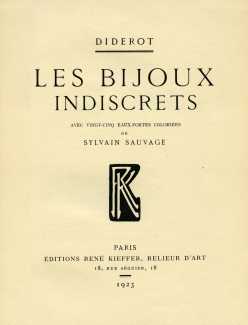
Sylvain Sauvage’s coloured etchings for Les bijoux indiscrets interpret Diderot’s text through the decorative idiom of the 1920s, cleverly combining the ‘Congolese sultanate’ of Mangogul’s court – really that of Louis XV – and a thoroughly modern Parisian taste for the exotic. His fine engraved lines are printed in a warm bistre rather than black, and hand-coloured afterwards in thin washes of lilac, turquoise, pale blue, ochre and magenta. Sauvage’s style is deliberately innocent and simple, his characters with their doll-like faces, dot eyes and rouged cheeks, by turns charming and grotesque. Many of the illustrations are framed by heavy draperies, several with a voyeur peeping from behind them, entirely appropriate for a book about secret sexual testimony being shared openly.
What we see in almost every image is astonishment, a gesture of shock or swoon, hands clapped to mouths and cheeks, eyes wide, heads thrown back – perfect for a narrative about involuntary confessions being overheard. A couple of the illustrations stand apart from the boudoir comedy and reach into Diderot’s philosophical frame; one is the loinclothed, bearded man blowing bubbles with a crowd of hands and heads reaching vainly upward to catch them, while the final plate of the book depicts the genie Cucufa as a towering hooded apparition among the clouds, a finger raised in instruction – or is it in warning?
The Sauvage-illustrated Les bijoux indiscrets was published by René Kieffer, Paris, in a limited and numbered edition of 600 copies.
An excellent translation by Sophie Hawkes of Les bijoux indiscrets has been published as The Indiscreet Jewels by Marsilio Classics. This edition also includes a comprehensive historical and literary introduction to the work and its author by Aram Vartanian.