Towards the end of 1931 the Berlin art dealer and publisher Wolfgang Gurlitt, directing the Galerie Fritz Gurlitt and still trading under his father’s name, commissioned Jeanne Mammen to illustrate a deluxe edition of Pierre Louÿs’s Les chansons de Bilitis. Gurlitt had already shown an interest in erotic livres d’artiste through his privately printed Venuswagen series, and Mammen’s modern, androgynous vision of Berlin lesbian life must have seemed ideally suited to Louÿs's pseudo-classical eroticism.
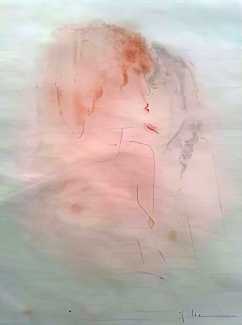
But the projected edition never appeared. After 1933 Mammen’s work was condemned by the new regime, the lithographic stones were suppressed, and the artist retreated into the ‘inner emigration’ that effectively ended the brilliant figurative phase of her Weimar career. What survives today appears to be little more than the remnants of an aborted edition – scattered artist’s proofs from a portfolio that was never formally issued. Yet the surviving sheets are among the most remarkable visual transpositions of Louÿs ever attempted. Rather than reconstructing an imagined antiquity, Mammen relocated Bilitis entirely into the world she knew, a world of the cabarets, salons, dressing rooms and dance floors of late Weimar Berlin, turning the poet’s courtesans and lovers into inhabitants of the city’s lesbian demi-monde. The result is intimate yet unsentimental, with scenes of tenderness and erotic companionship set against the harder realities of performance, commerce and social display.
The challenge of the portfolio is that the Bilitis cycle has never existed in a fully stable or documented form. In the 1997 catalogue raisonné by Döpping and Klünner, only seven motifs were recorded, and even there both the intended size of the edition and the total number of designs remained uncertain. Then, in 2013 two further lithographs – Frau und Mädchen and Bordellszene (a variant of the known Die Wahl) – emerged unexpectedly from the former Schoenberner collection in Munich, bringing the known corpus to at least eight lithographs. This explains the persistent confusion in museum texts and online sources.
Thus the cycle survives not as a finished livre d’artiste but as a reconstructed body of evidence, fragments of an unrealised publication whose shape has to be pieced together from versions dispersed across different galleries, collections and the art market. The titles that have been given to the known prints are:
Eifersucht (Jealousy)
Am Morgen (In the Morning)
Bordellszene (Die Wahl) (Brothel Scene – The Choice)
Siesta
Beim Schminken (At her Make-up)
Damenbar (Women’s Bar)
Frau und Mädchen (Woman and Girl)
Freundinnen (Friends)
Jeanne Mammen’s Bilitis plates have sometimes been suggested as evidence, alongside her other depictions of lesbian and women-only bars, to suggest that she was a lesbian herself. The truth is that while she was fascinated by social interactions, and had important long-lasting friendships with both women and men, she valued most her absolute independence, famously once stating ‘I always wished to be just a pair of eyes, to explore the world without being seen, only to see others.’