When Tee Corinne self-published the Cunt Coloring Book in San Francisco in 1975, she intended it as both an artist's book and an educational statement. The project had begun two years earlier, when she set out to produce drawings of women’s genitalia for use in feminist consciousness-raising groups and sex education workshops. Her own art training had taught her to draw the male body in detail, yet she realised that she had rarely seen accurate representations of female genitalia and knew little about their natural variation. Drawing from life, using friends and fellow feminists as her models, she produced a series of carefully observed line drawings celebrating the individuality and diversity of women’s bodies.
Corinne chose the colouring-book format deliberately. Rather than presenting clinical anatomical illustrations, she hoped that colouring the images would encourage women to look closely at their own bodies and replace embarrassment with familiarity and pride. Equally important was her decision to use the word ‘cunt’ in the title. At a time when the term was almost invariably used as an insult, she sought to reclaim it as a positive and unapologetic description of female anatomy.
Published under Corinne's own Pearlchild imprint, the book was distributed largely through the growing network of feminist bookshops, women’s health collectives, lesbian organisations and alternative presses that emerged during the 1970s. These independent publishing networks enabled writers and artists to reach audiences that mainstream publishers were still reluctant to serve, and the Cunt Coloring Book quickly became one of the best-known publications of the women's movement.
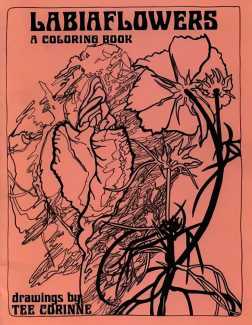 In 1981 the pioneering lesbian publisher Naiad Press republished the work under the more commercially acceptable title Labiaflowers. Founded in 1973, Naiad became one of the most influential publishers of lesbian literature in the United States, providing a vital outlet for writers who remained largely excluded from mainstream publishing. Although the revised title allowed some booksellers to stock the book more comfortably, Corinne later remarked that sales declined dramatically. When the San Francisco countercultural publisher Last Gasp restored the original title in 1988, the book’s popularity quickly revived. Corinne herself saw this as evidence that reclaiming language was as important as reclaiming imagery. Today the Cunt Coloring Book remains one of the most recognisable and enduring publications of the feminist art movement.