
Hans-Jürgen Döpp – a tribute
Hans-Jürgen Döpp (3 May 1940–30 January 2025) – the collector who shared a hidden history of desire
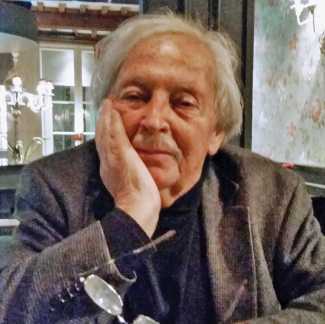 Some figures shape a field not by standing at its centre, but by preserving, interpreting and sharing what others overlook. Hans-Jürgen Döpp, who died last year at the age of 84, was one such figure. For more than half a century Hans-Jürgen devoted himself to the study and collection of erotic art, not as a marginal curiosity or a private indulgence, but as an essential part of human culture. Through his work as a scholar, teacher, curator, author and collector, he helped establish erotic art as a serious field of artistic and historical enquiry.
Many people who knew Hans-Jürgen remembered him from his many years teaching at the Johann Wolfgang Goethe University in Frankfurt, where he held a chair in psychoanalytical interpretation and the cultural history of erotic art. Others knew him through his work curating exhibitions, including the conceptual design and curation of the former Erotic Museum in Berlin. In later years, as he became a sought-after author and contributor to a series of books on erotic art, he became increasingly recognised as one of the major collectors in the field, eventually assembling one of the most important collections of erotic portfolios of his time.
Hans-Jürgen spent more than half a lifetime rescuing, studying and sharing the history of erotic art. His generosity helped preserve hundreds of rare portfolios and ensured that works once hidden in private collections could reach a wider audience. Over more than six years he shared many portfolios from his collection with honesterotica, and we are enormously grateful for the extraordinary contribution he made to the site’s archive. Portfolios made available through his kindness are in important part of the site’s collection, ensuring that these artists and their work continue to reach new audiences.
A collector with a purpose
Hans-Jürgen’s collection was built over more than three decades of searching, research and curiosity. Like many great collections, it reflected the personality of its creator: wide-ranging, intellectually engaged and unwilling to accept the boundaries imposed by conventional taste. He collected drawings, prints, illustrated books, portfolios and rare publications spanning centuries of erotic imagery. His interests extended from historic works to modern illustration, from celebrated artists to those who had slipped into obscurity. He also commissioned new work from artists whose work he admired.
For Hans-Jürgen, collecting was never merely about possession. A collection had meaning because it created relationships – between the artist and the viewer, between past and present, and between individual works that might otherwise remain isolated. In his conversations with honesterotica, he spoke of the importance of allowing collections to be seen. He rejected the idea that rare erotic material should become a kind of secret property, hidden away from public appreciation. A collection, in his view, was a living thing: something that gained value through discovery, discussion and exchange.
From private collection to shared resource
This attitude made Hans-Jürgen unusual among collectors, particularly in a field where many works exist in small editions, private archives, hard-to-access library holdings and fragile bibliophile publications. Over many years he generously shared material from his collection with honesterotica, providing hundreds of high-quality scans of portfolios and works that might otherwise have remained accessible only to a handful of specialists. The importance of that generosity is difficult to overstate. A physical collection can be dispersed – books and artworks can move between owners, disappear into private libraries, and become inaccessible. Digital preservation creates a different kind of continuity – it allows works, artists and ideas to remain connected even when the original objects are separated.
Hans-Jürgen understood this instinctively. His support for honesterotica reflected the same principle that guided his own collecting, that erotic art deserved to be studied, appreciated and shared. His own Venusberg website, for many years a showcase for his collection and publications, included a warm link to honesterotica, an acknowledgement that both projects shared a common purpose in bringing neglected and fascinating material to a wider audience. Hans-Jürgen was not simply a source of images, he was a collaborator in the preservation of a visual history.
The importance of an overlooked history
Erotic art has often occupied an uneasy position within cultural institutions. Although sexuality has always been a central theme of human creativity, erotic works have frequently been excluded, hidden or treated as somehow separate from ‘serious’ art history. Collectors such as Hans-Jürgen played a crucial role in challenging that separation. By preserving works that others ignored, he helped demonstrate that erotic art is not an isolated category but also connected to illustration, printmaking, literature, publishing, social history, and changing attitudes towards the body and desire.
His scholarship and writing reflected this belief. He approached erotic art not simply as a subject of fascination, but as a way of understanding human imagination, psychology and culture. For Hans-Jürgen, eroticism was not reducible to explicit imagery. It depended on suggestion, fantasy, emotion and the creative space between artist and viewer. The imagination was as important as the image itself. He was preserving objects, but he was also, and just as importantly, he was preserving different ways of seeing.
The future of the collection
A substantial portion of Hans-Jürgen’s collection was offered at auction in 2024 in the sale Erotica – Aus der Sammlung Hans-Jürgen Döpp at Nosbüsch & Stucke in Berlin. The sale dispersed many works that had formed part of his remarkable collection, placing them into new hands and new contexts, and Hans-Jürgen was pleased to see many exceptional lots go into collections that he knew and had worked with. This is the natural fate of many great private collections – objects move on, collections change, but the vision behind them can survive, especially when the collector has understood that preservation means more than ownership.
For many artists and portfolios represented through honesterotica, Hans-Jürgen’s generosity has created a lasting public record of material that might otherwise have remained hidden within a private collection. The website now stands, in part, as a testament to his belief that rare and important works should be available to all those who wish to study, appreciate and understand them.
A legacy of generosity
It is perhaps fitting that Hans-Jürgen’s greatest contribution may not be measured only by the number of works he owned, the books he wrote or the exhibitions he curated. It may instead be measured by the number of people who were able to discover artists and works because he chose to share his passion.
Collectors are often described as guardians of the past. Hans-Jürgen embodied the best meaning of that phrase. He cared for fragile, overlooked and sometimes misunderstood material, but he did not believe that guardianship meant keeping things locked away. His collection was a conversation, and he wanted others to join it. Through the books he published, the exhibitions he organised, the collection he built and the hundreds of portfolios he made available through honesterotica, Hans-Jürgen ensured that a rich and often neglected part of artistic history would continue to be seen.
The physical collection may now be scattered, but the generosity behind it remains.
