
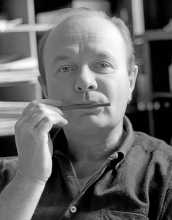
 Keith Vaughan occupies a singular place in British post-war art, a painter of brooding, monumental male figures whose work was inseparable from the tensions of his inner life. Though celebrated for his more approachable work in his lifetime, until recently he has not received the full recognition his achievement deserved, partly because the subjects of his canvases – naked, muscular men arranged in quasi-mythological groupings – made the establishment uneasy. Today he is rightly understood as one of Britain’s most important gay artists, and the complexities of that identity drove everything he made.
Vaughan was largely self-taught, having worked in advertising before the second world war redirected his energies toward painting. His wartime experiences, including serving as an interpreter in prisoner-of-war camps, deepened his introspective nature and sharpened his interest in the human figure. By the late 1940s he had found his subject – the male nude.
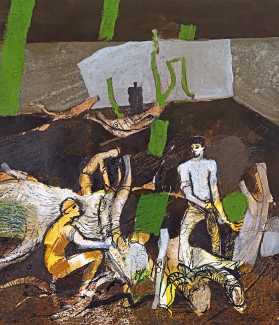
His figurative paintings draw on a range of sources – Cézanne’s bathers, the weight of Henry Moore’s sculptural forms, the chromatic intensity of Nicolas de Staël – but the synthesis is entirely his own. Groups of male figures populate spare, elemental landscapes: beaches, clearings, anonymous outdoor spaces that feel both ancient and timeless. The men are rarely individualised. They are types, archetypes even – shoulders heavy with classical precedent, limbs rendered in ochres and earth reds, faces averted or obscured. There is tremendous physicality in Vaughan’s work, but it is also strangely melancholy, as though desire and beauty are perpetually out of reach.
This sense of longing was not incidental. Vaughan was gay at a time when male homosexuality was not only socially stigmatised but, until the Sexual Offences Act of 1967, a criminal offence in England. He kept an extraordinarily candid private journal across much of his adult life, in which he wrote with painful frankness about his sexuality, his attractions, his loneliness, and his fear. He described himself as inhabiting a double life – the respected, prize-winning artist on one side, and on the other a man whose desires placed him perpetually outside the law and, he feared, outside society's sympathy.
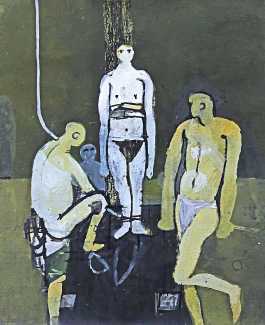
This fracture informed his art profoundly. The male figures in his paintings can rarely touch or meet each other’s gaze. Proximity and distance are held in careful, charged suspension. Critics have long noted that Vaughan found in paint a freedom unavailable to him in life – a space where the male body could be celebrated, desired, and dwelt upon without shame or legal consequence. The anonymity of his figures was both artistic strategy and personal protection. In his silent assemblies of male bodies – urgent, tender, unresolved – something essential about suppressed desire and sublimated life finds its most eloquent form.
His journals, published posthumously, reveal the full weight of what he carried. Even on the night of his death, a planned, self-administered overdose following a cancer diagnosis, he continued writing until near the end. The journals are a remarkable body of writing – funny, despairing, intellectually fierce, and achingly honest about what it cost to live as a gay man in mid-century Britain.
Vaughan’s reputation has grown considerably since queer art history began recovering figures obscured by prejudice and critical neglect. His paintings hang in the Tate, the British Council collection, and major regional galleries.
The Keith Vaughan Society, dedicated to the promotion and understanding of the artist and his work, can be found here.
Similar artists
Patrick Angus – American painter of urban gay life and intimate scenes.
Neel Bate – American mid-century illustrator of homoerotic subjects.
Jean Cocteau – French artist and writer of homoerotic drawings and literature.
Peter Flinsch – German-Canadian illustrator of mid-century homoerotic subjects.
Touko Laaksonen – Finnish illustrator of idealised homoerotic figures.
Tom Poulton – British illustrator of mid-century homoerotic physique subjects.
Example illustration


