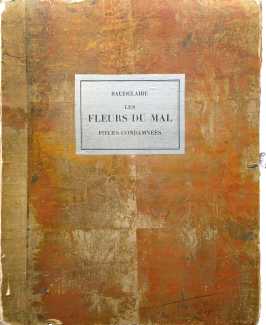
 Charles Baudelaire’s celebrated poem cycle Les fleurs du mal (The Flowers of Evil) was first published in 1857, but the court-ordered suppression of six poems from that first edition meant that neither it nor its successors could legally include them in France. These poems became known as Les pièces condamnées (The Banned Poems), which were omitted at the demand of the French government censors. The ‘forbidden’ poems (‘Lesbos’, ‘Femmes damnées (à la pâle clarté)’, ‘Le Léthé’, ‘À celle qui est trop gaie’, ‘Les bijoux’, and ‘Les métamorphoses du vampire’), did however appear in print in 1866, published in Brussels as Les épaves (literally ‘flotsam, the debris from a shipwreck’), specifically to circumvent French law, with a frontispiece by Félicien Rops.
The suppression order was not formally lifted until May 1949, meaning the poems were technically banned in France for 92 years. This made Les pièces condamnées particularly attractive to publishers of limited illustrated editions, giving this edition of 1931 a particular edge – the fact that it was still illegal in France at the time of publication explains the small edition and the subscription-only method of its circulation.
For this portfolio Picart Le Doux worked in ink wash, also known as lavis, a technique that suited his temperament as a draughtsman better than engraving would have done. Rather than building up tone through patient cross-hatching, lavis allows broad gestural marks and sudden deep blacks, and Le Doux exploits both to the full. The result is a series of plates in which the backgrounds often threaten to overwhelm the figures entirely, pools of near-black ink pressing in on the paleness of the bodies. This tonal drama gives the plates an almost cinematic quality.
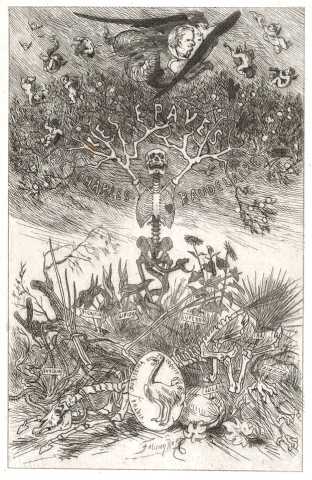
The female figures are unmistakably of their time – dark-haired, jewelled and exotic. The frontispiece sets the emotional tone for the portfolio. A death’s-head skeleton serenades an indifferent woman, a motif that descends directly from Rops. Picart Le Doux keeps Rops’ iconographic inheritance but strips away the obsessive detail, rendering the scene in a loose, sardonic manner. This is not luxurious eroticism – it is something darker and more ambivalent, well matched to poems that a French court had judged unfit for public morality more than seventy years earlier.
The portfolio was published by Paul Cotinaud, who seven years earlier had appeared on the erotica scene through his collaboration with the artist Sylvain Sauvage on Une aventure de Casanova. Cotinaud then applied the same model of luxury editions and collectors’ suites to illustrated works, including Vertès’ Entrée interdite au public (1926) and Collot’s Contes de Boccace (1930). Over roughly a decade he assembled a serious erotic bibliophile list before shifting in the 1940s toward the more respectable Éditions du Rameau d’Or imprint and its illustrated classics. Almost nothing is known about Cotinaud himself, a common fate among discreet Parisian publishers working partly in the erotic trade, but the books suggest a career extending from at least 1920 to around 1960. His use of the prestigious Coulouma press in Argenteuil places him firmly within the interwar fine-press network, while his repeated collaborations with the writer Pierre Mac Orlan imply a close personal connection as well as a professional one. Beyond the publications themselves, however, virtually no biographical trace survives.
Les fleurs du mal: Les pièces condamnées was published by Paul Cotinaud in a limited numbered edition of 257 copies.