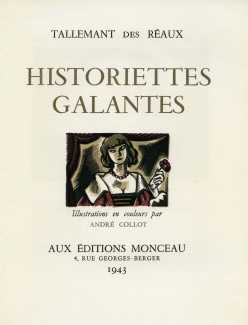
 Gédéon Tallemant des Réaux (1619–92) was a well-connected observer of Parisian and court society who spent the 1650s and early 1660s recording anecdotes, gossip, character sketches and private recollections about the people who shaped the social and cultural life of seventeenth-century France. The resulting Historiettes, never intended for publication, circulated privately before first reaching print in Monmerqué’s edition of the 1830s. Precisely because it was written for private readers rather than the public, it preserves an unusually candid portrait of the world of Louis XIII, the regency and the early reign of Louis XIV, recording not only public reputations but also the scandals, intrigues, rivalries and eccentricities overlooked by official histories.
This much-abridged selection reworks Tallemant’s vast Historiettes, stripping away the statesmen, soldiers, churchmen and literary figures who occupy much of the original manuscript in order to emphasise its erotic content. The result is a carefully curated panorama of seventeenth-century sociability, organised around love affairs, sexual intrigue, domestic comedy and aristocratic reputation.
Among the most memorable portraits are those of Ninon de Lenclos and Marion de L’Orme, the two women who came to embody the libertine imagination of the age. Tallemant presents Ninon as an independent-minded courtesan and freethinker whose romantic philosophy and celebrated wit challenged conventional expectations of female behaviour, while the liaisons of Marion de L’Orme linked the worlds of courtly ambition and private passion. Other figures, such as Madame de Sablé, whose literary salon helped shape elite intellectual culture, and the turbulent Madame de Courcelles, whose love affairs, legal battles and imprisonments unfold like episodes from a novel, demonstrate Tallemant’s gift for transforming social observation into compelling narrative.
The second section of this edition, historiettes collectives, adopts a different but equally revealing strategy. Instead of individual portraits, it assembles thematic clusters including cuckolded husbands, husbands who overlook their wives’ dalliances, and the experiences of older women who remarry. These collective chapters gather brief anecdotes into comic categories, transforming Tallemant’s sprawling accumulation of gossip into a structured gallery of social types.
André Collot’s thirty wood engravings for this edition, printed in black, ochre and burgundy, demonstrate his mastery of the medium, one that he had only seriously attempted a year earlier with his L’enfer des classiques portfolio; it seems a pity that he did not take it any further, as his engraving is just as skilled as that of masters like Jean-Gabriel Daragnès. Collot’s handling of the technique is a perfect match for Tallemant’s bold narratives, with the same sharpness of line and economy of effect. He stages each scene like a small theatre, framed by bed-hangings and candlelight, and if his gallant gentlemen wear the ruffs and doublets of Tallemant’s century, his women are unmistakably modern – a knowing touch entirely in the spirit of the book.
Here are the contents of this edition:
Historiettes galantes
Madame de Reniez
Madame de Sablé
Marion de L’Orme
Madame de Thémines
Madame de Liancourt
La Comtesse de Vertus
Madame de Montbazon
Madame de Montandre
Madame de Champré
Madame de Cavoye
Madame de La Grille
Madame de Courcelles
Madame de Gondran
Ninon de Lenclos
Madame de Castelmoron
Madame de Vervins
La Belle Liance
Madame de Miramion
Historiettes collectives
Marys cocus (Cuckolded Husbands)
Cocus prudents (Prudent Cuckolds)
Jaloux (Jealous Men)
Catalogne (Catalonia)
Femmes vaillantes (Valiant Women)
Vieilles remariées (Remarried Older Women)
Amans malheureux (Unfortunate Lovers)
Extravagants (Eccentrics)
Bizarreries (Oddities)
The Collot-illustrated Historiettes galantes was published in Paris by Éditions Monceau in a limited, numbered and boxed edition of 1,000 copies.