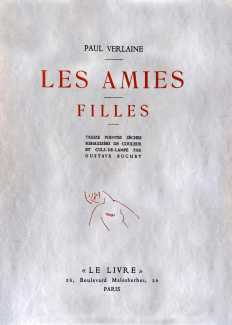
 In his only published erotic portfolio, Buchet approached the pairing of Paul Verlaine’s notorious Les amies of 1867 and Filles from Parallèlement with his own singular perspective, a draughtsman’s economy that is wholly of its time, combining art deco treatment with a purist, almost cubist, simplicity. Les amies – Filles appeared at the very crest of Buchet’s avant-garde years, newly settled in Paris, showing with the Section d’Or, fresh out of the Geneva dada explosion, and deep in his assimilation of Fernand Léger’s post-cubism and the purism that Le Corbusier was preaching.
Each of his figures is built from a few long, unhurried contours that sweep the length of a thigh or the curve of a back without lifting, the body summarised rather than described, its volume left as bare paper and conjured only by short banks of parallel hatching laid along the edges where the form turns. Alongside this rigour he sets a decorative vocabulary of vertical dashes, stripes, grids, and scattered floret-marks for the wallpaper and the air itself, looping corkscrews for hair, scalloped runs of small loops standing in for lace and the frilled hems of lingerie, undulating wavelets for the sea.
Throughout the portfolio the eroticism is carried by pose and atmosphere – the heavy-lidded surrender, the loose limbs, the mask-like faces downcast or closed-eyed, the mouth a single red note, the cheek touched with a circle of pink. The elongation and serene blankness of these women carry an echo of Modigliani, a connection perhaps not coincidental given Buchet’s friendship with Modigliani’s artist companion and model Jeanne Hébuterne.
The plates are drypoints, the burr of the needle visible in the soft, slightly furred weight of the contour. The colour is not Buchet’s, but was added in pochoir stencil by Jean Saudé, the foremost Parisian colourist of the day, which explains the flat, translucent washes reserved for the hair, drapery and ground, while the skin is left as untouched paper with only the smallest accents picked out.
The Buchet-illustrated Verlaine was published by Le Livre, Paris, in a limited numbered edition of 425 copies.