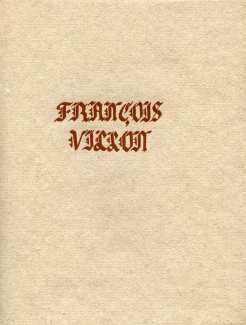
 Of all the books André Collot illustrated, this is perhaps the strangest and the most inventive – a book that disguises itself as something four hundred years older than it is, and then fills that disguise with erotica.
A word first about the poet. François Villon, born in 1431, was the greatest French poet of the late middle ages and also a thief and brawler, twice condemned by the courts, once sentenced to hang, and finally banished from Paris – he vanished from the record around 1463 and was never heard of again. His verse is unlike anyone else’s of the period, bringing two worlds together, on one hand a tender, aching melancholy for the passing of youth, beauty and time, and on the other the coarse, vivid life of the taverns, back-streets and brothels he knew at first hand. It is poetry that can move from a prayer to a dirty joke in the space of a line.
Collot’s response to Villon is remarkably ingenious. Rather than simply illustrate the poems, he has dressed the entire book as a medieval illuminated manuscript – the ornate, hand-painted kind of prayer-book a wealthy reader of the fifteenth century might have owned, reproducing every one of its features – dense gothic script, gleaming gold, and borders of ivy, flowers and foliage. But there is a mischief built into this. Real prayer-books of the period often incorporated comic figures in the margins – people drinking, quarrelling, baring their backsides, even coupling – as a kind of licensed naughtiness at the edge of a holy text. Collot takes that tradition and adds erotic plates to Villon’s equally bawdy text, creating a witty fusion between the originally-sacred form of the book and the thoroughly profane life of the poems in it.
The book contains ten Collot plates, illustrating four of Villon’s best known – and most frankly sexual tales. The collection opens with Ballade de la grosse Margot (Ballad of Big Margot), Villon’s brothel ballade, with its refrain ‘en ce bourdel où nous tenons nostre estat’ (in this brothel where we hold our court). In the Ballade des dames du temps jadis (Ballad of the Ladies of Times Past), the wistful poem with the famous refrain ‘mais où sont les neiges d’antan?’ (but where are the snows of yesteryear?), the elegy for vanished beauties is set against a barber’s razor glinting at a woman’s groin and a floor spattered with blood. The Contredictz de Franc Gontier (Franc Gontier Contradicted), Villon’s sneer at the supposed joys of the simple life, shows a fat grinning canon in bed with his young mistress, wine in hand. In Les regrets de la Belle Heaulmière (The Regrets of the Fair Armourer’s Mistress) we read the lament of an old woman for the body she once had. She crouches over a dying fire, and in the rising smoke Collot conjures the ghost of her lost young form, reflecting the poem’s deep sorrow.
The images themselves are not engraved on metal, as has sometimes been claimed, but printed from wood or a similar raised block, coloured entirely by hand through stencils and touched with real gold, giving the flat, bright, shadowless brilliance of the manuscripts he imitates. The printing and colouring were entrusted to two of the most accomplished and specialised Parisian firms of the 1930s, Les Frères Vauchez for the printing and Vairel Fils as the colourists. Printed as the book is on fine Montval laid paper, the quality of the production was never bettered in the period.
Nothing quite like it exists from Collot’s own century. He reaches back over four hundred years to revive the design traditions of the medieval prayer-book, then carries them further than any medieval artist would have dared into explicit and cheerful erotica.
The Collot-illustrated Ballades de François Villon was published by the Paris publisher Paul Cotinaud, in a limited, numbered and gold-boxed edition of 300 copies.