
The difficult mirror
Artists, childhood, and the challenge of looking
What do the honesterotica-featured artists Balthus, Trevor Brown, Nicole Claveloux, Silvio Cadelo, Lena Cronqvist, Edgar Degas, Albert Dubout, Leonor Fini, gea*, Gustav Klimt, Jim Herbert, Charles Laborde, Stu Mead, Rojan, Egon Schiele, Joaquín Sorolla y Bastida, Johannes Spehr, Ida Teichmann, Martin van Maele and Marcel Vertès have in common? The answer is that although they span centuries, countries, and radically different artistic traditions, what they share is that they have all, at different points in their careers and for very different reasons, painted or drawn unclothed children. Yet examples of this aspect of their work are surprisingly difficult to find, especially online. When it does become a subject of discussion, critics and commentators often seem reluctant to describe what is actually depicted, resorting instead to euphemisms and vague generalisations rather than direct description and discussion.
There is a particular discomfort that attends any serious discussion of the relationship between childhood, embodiment and sexuality in visual art, a flinching which, while perhaps understandable, has done genuine damage to critical discourse around artistic freedom and the complexities of representing childhood. The result has often been a strange bifurcation – on one side, work that sanitises childhood into sentimental unreality; on the other, work that deliberately courts controversy by exploring conventionally taboo subject matter. Between these two approaches lies a much harder, more honest territory that serious artists have always known they must enter, sometimes at considerable personal and professional cost.
The argument for engaging with this territory seriously is not prurient. At its core it’s an argument about truth. Childhood is not, and never has been, a sealed-off realm of innocence untouched by the realities of bodily development and adult society. Children are curious about bodies from a very early age. They absorb the sexual atmosphere of the adult world around them, often without appropriate information and understanding, and with a large dose of adult embarrassment and commercial and social stereotyping. They are vulnerable to this confusion in ways that too often cause lasting harm. They experience their own dawning physicality with a heady mix of excitement and wonder, confusion and learned shame, and any artist attempting to depict the world of childhood honestly has to reckon with all of this.
This brings us to a simple but often overlooked truth – that all these artists are adults, adults looking at children, remembering themselves as children and interpreting those ever-more-distant memories. Childhood occupies a uniquely charged place in human experience. It’s a state that every adult has inhabited, but one that can never be fully recovered or re-entered. When as adults we create or encounter artistic representations of children, we are not neutral observers – we bring all of our own memories of curiosity, confusion, excitement, vulnerability, dependence, embarrassment, being seen, assessed and judged by others. Even when we do our best to imagine the child’s point of view, we are still imagining it as a knowing adult.
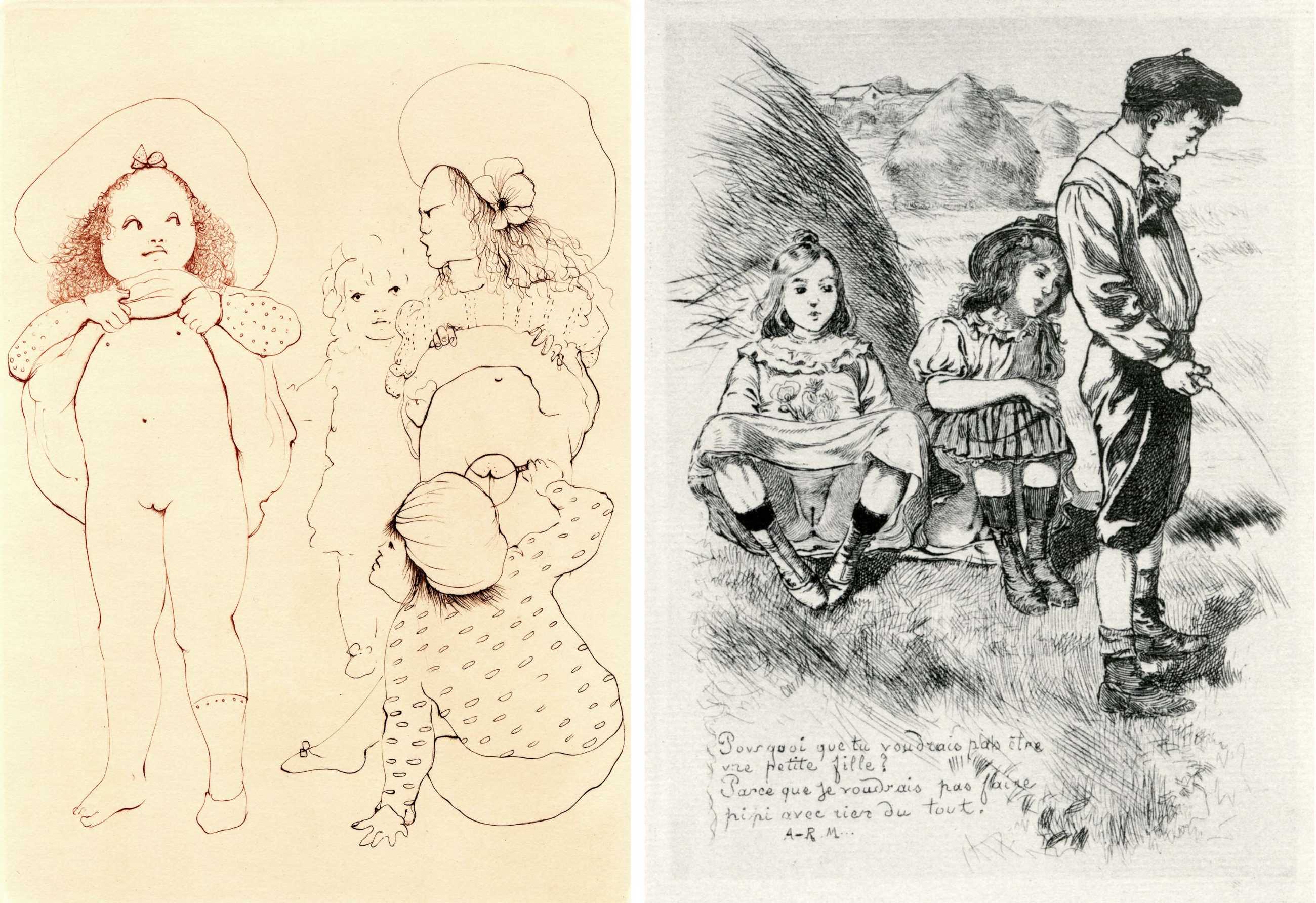 Look at these two images, the first from Leonor Fini’s Les petites filles modèles (1973), and the second from Martin van Maële’s La grande danse macabre des vifs (1905). Both show young children apparently engaged in a childlike curiosity about bodies and anatomy.
Fini was an artist deeply concerned with identity, transformation, power, and the instability of conventional categories. Her work resists easy readings – her figures can be simultaneously theatrical, vulnerable, mysterious and symbolic. Fini’s children often exist in a hybrid psychological space between the real and the imagined. Van Maële takes us into a very different world, the world of fin-de-siècle satire and social comment, the stripping away of prettiness. Mortality exposes the body beneath status, wealth and convention. Van Maële’s children belong to an earthy, irreverent world, where bodily realities are part of the comic, mortal condition of being human.
Fini was creating a suite of illustrations to accompany a favourite classic about naughty children; Van Maële was creating images about aspects of bodily function to remind his audience that we are all naked under our clothes, that we have all been children, and we will all die. What was their purpose in creating the images? For Fini it was a later-life commission for a high-quality limited edition portfolio; for Van Maële it was also for a small audience of ‘connoisseurs’.
And what do we, the modern viewers of the images, see? Aspects of childhood innocence to smile with and remember? Embarrassing incidents from our own youth? Scenes we would rather not see? What might the gallery audience see? What might the internet audience see? What might online algorithms see? The more we ask and try to respond to these questions, the more the ‘difficult mirror’ becomes not so much about the artwork itself, but about the encounter between artist, image and viewer. Who creates, who interprets, and who responds. It asks what we remember about being children, what we have forgotten, and whether we are willing to look honestly at the complexity of the human experience that childhood represents.
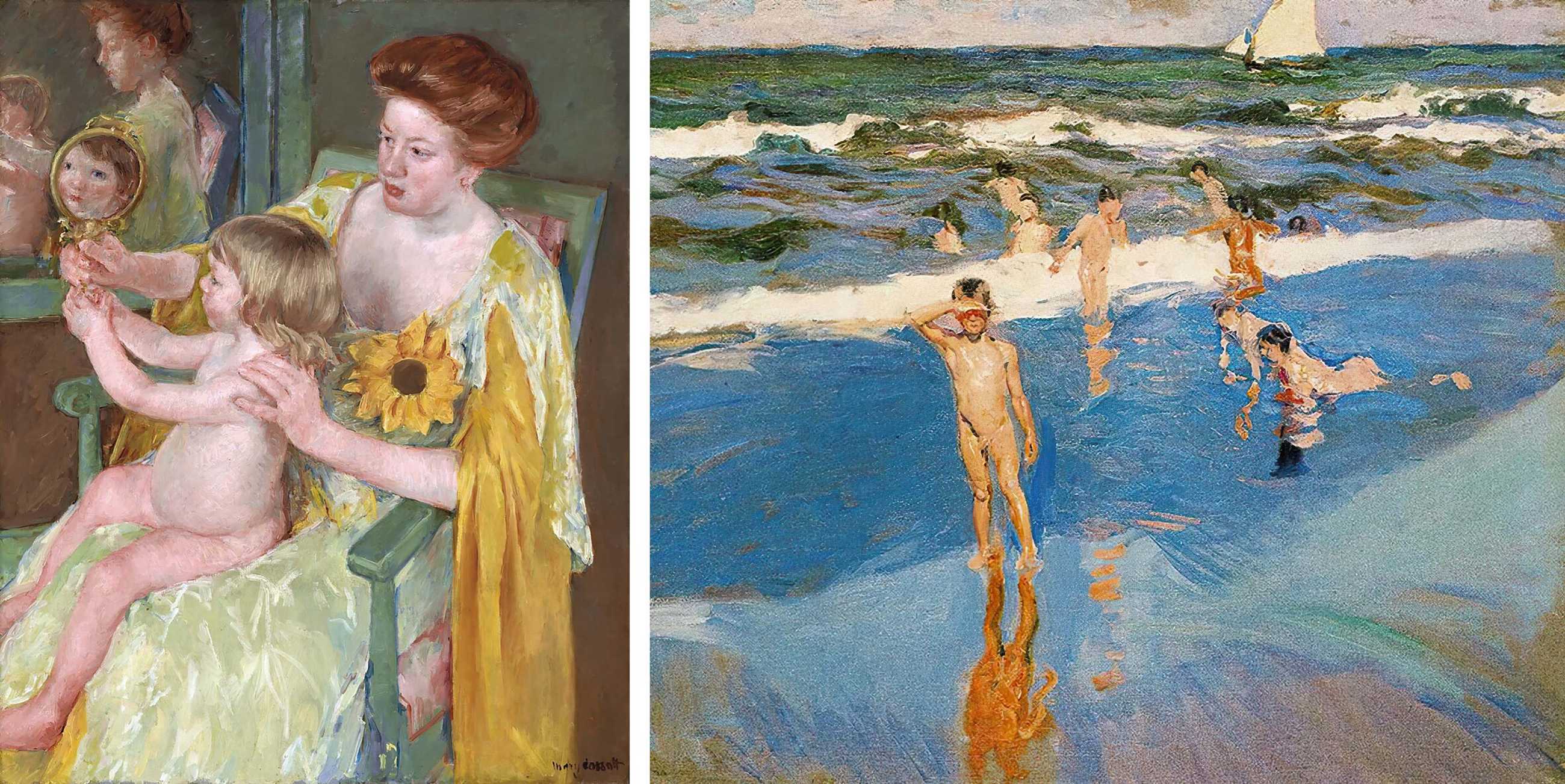 Here are two more images, Mary Cassatt’s 1905 painting Woman with a Sunflower (The Bath), and Joaquín Sorolla y Bastida’s 1908 Children in the Sea, Valencia Beach. Both have been exhibited publicly since they were painted, receiving much praise – Cassatt for her portrayal of domestic intimacy and Sorolla for his mastery of sunlight. And despite both featuring naked young children, neither has been the subject of any sustained criticism as a result.
Why might this be? Are paintings like these generally perfectly acceptable because they offer culturally reassuring images of childhood, or have they become ‘safe’ through long acquaintance and the approval of the art world?
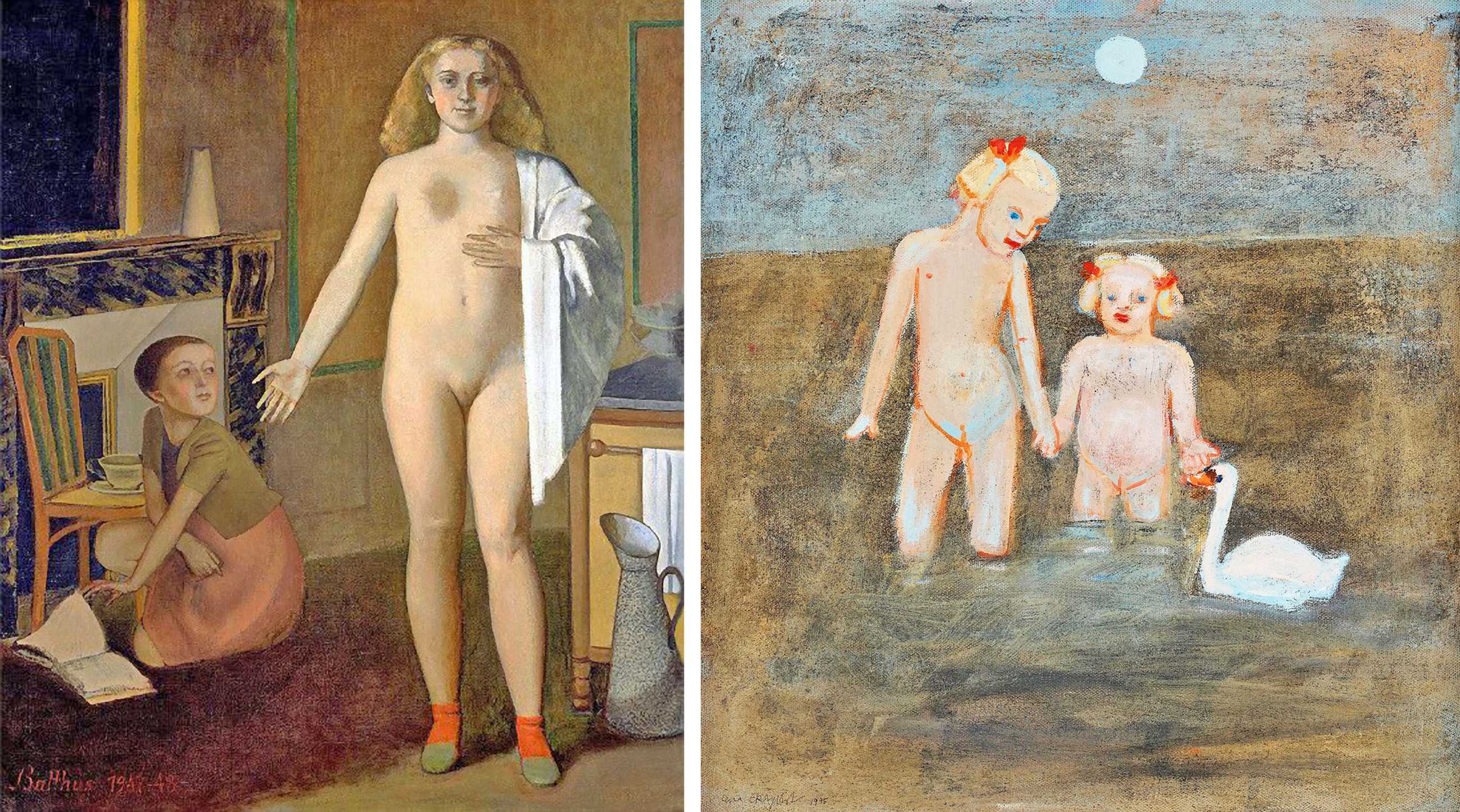 What happens when images of childhood escape such a safety net, and critics start asking questions about propriety and public visibility? Here are two more images – Balthus’s 1938 painting The Room, and Lena Cronqvist’s 1995 painting The Swan. Now both artists have moved beyond observed reality into a more ambiguous psychological world, recognisably everyday yet subtly estranged, where childhood becomes more complex and harder to interpret. Both of these paintings also share the dubious honour of being considered for removal from major exhibitions because of their subject.
As viewers the questions now become more nuanced. In the Balthus do we first see the naked girl and wonder why she is naked, or do we see the interaction with the other figure and her book, and think about what the painting is saying about innocence and fantasy? Do we see Cronqvist’s little girls enjoying the cool water and the inquisitive swan, or do we think their parents should have invested in infant bikinis?
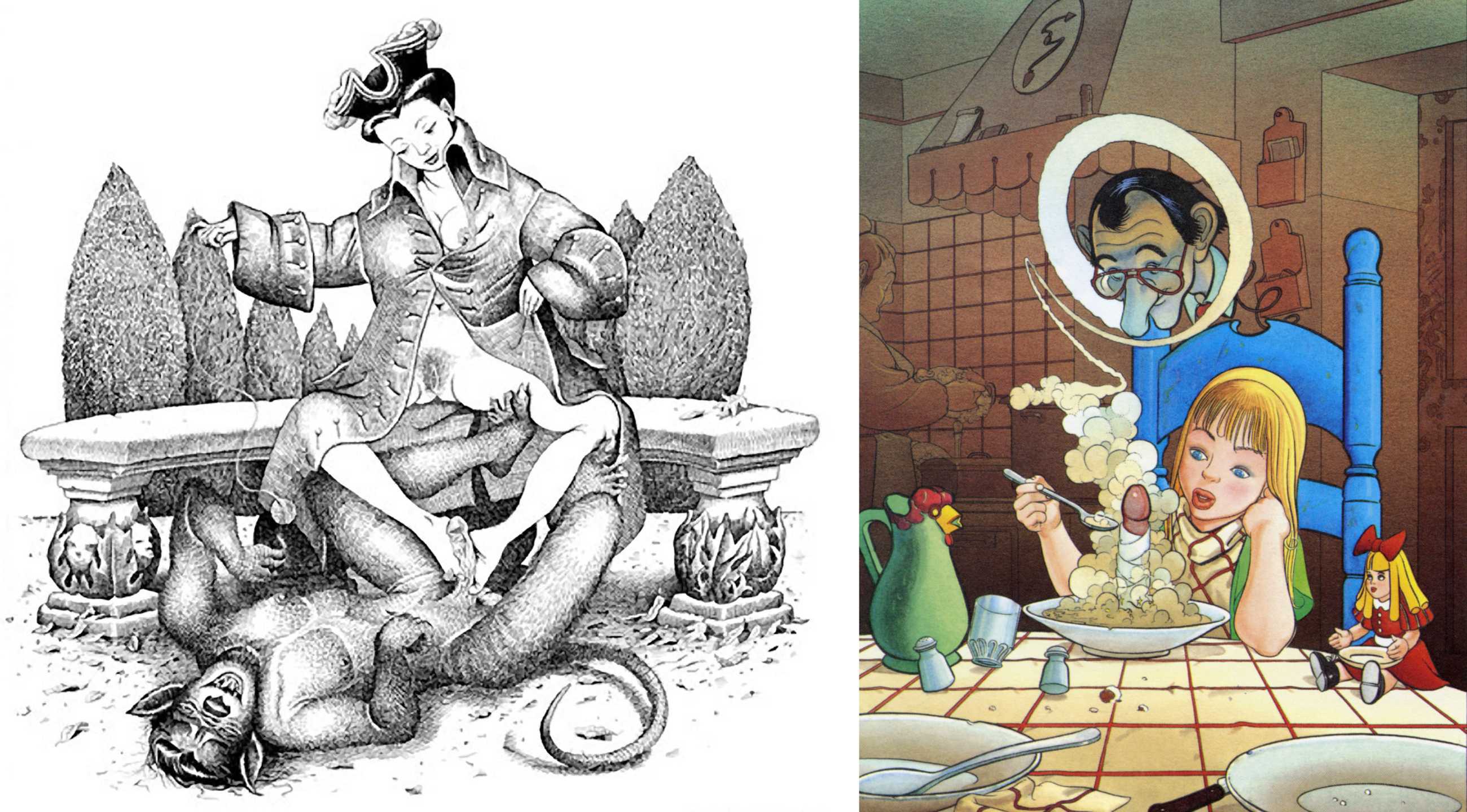 Next we move into literary territory, with images from Nicole Claveloux’s 2003 Morceaux choisis de la Belle et la Bête (Selections from Beauty and the Beast), and from Silvio Cadelo’s Perverse Alice from 1989.
Claveloux’s illustrations emphasise the journey from adolescent fear and uncertainty towards adult intimacy, desire and choice, an important aspect of the Perrault tale that has always been present but is often softened in modern retellings. In the refined pen-and-ink work, Beauty is rendered with genuine psychological complexity – curious, apprehensive, exploring the stirrings of desire, actively negotiating with the Beast rather than passively submitting.
Silvio Cadelo reimagines Lewis Carroll through a psychoanalytic lens, with Alice sitting at a kitchen table eating soup with a phallic centrepiece, out of which rises in a cloud of steam a grotesque, exaggerated male face – spectacled, bulbous-nosed, faintly leering – which the girl regards with an expression of curiosity, mild alarm, and unimpressed wariness children sometimes offer when they experience adults behaving oddly.
Claveloux and Cadelo use pre-existing literary figures already associated with contested adult investment in childhood – Beauty and the Beast explicitly about the eroticisation of fear, and Alice pre-loaded with critical awareness of Carroll’s own relationships with children. The artists are working with and against an established interpretive tradition rather than establishing one from scratch.
This raises an uncomfortable question which requires acknowledgment – is the literary source doing the moral and artistic heavy lifting that the image itself should be doing? Maybe the genuinely more demanding artistic achievement is original work that creates its own context, establishes its own critical distance, and earns its seriousness without borrowed literary authority. Do the literary links absolve an artist from personal responsibility for their work, or rescue us as viewers because the erotic literary precedents have already been set and interpreted?
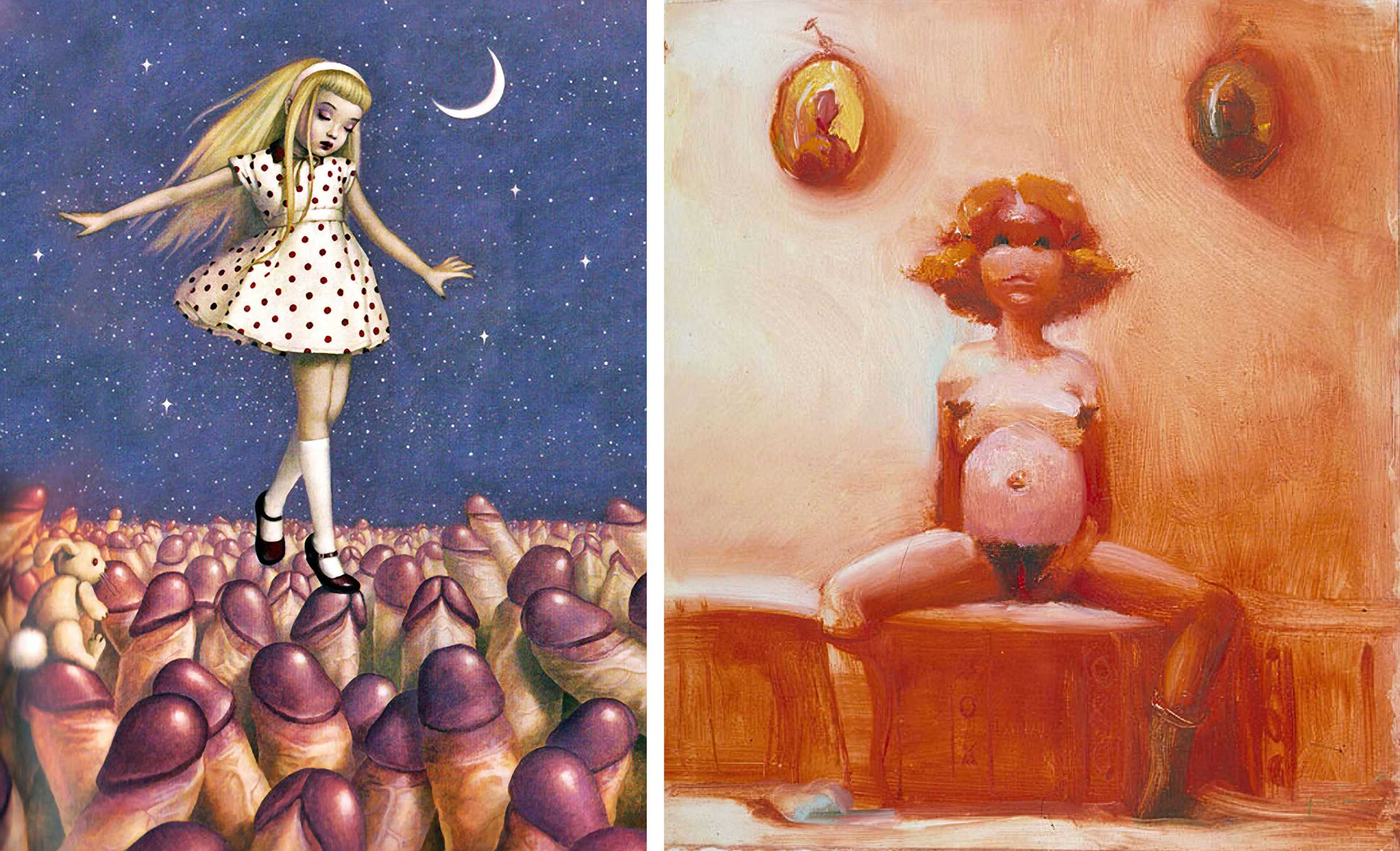 The next two images take us into more deliberately constructed and artificial worlds, where the familiar languages of childhood, beauty and desire are disrupted and where both artist and audience are required to engage more critically. The first is from Trevor Brown’s Forbidden Fruit of 1997; the second Lisa Yuskavage’s Red Head with Portraits from 1996.
Trevor Brown draws on the traditions of children’s book illustration, pop-cultural cuteness and underground aesthetic, so we recognise familiar childhood visual codes – sweetness, innocence, playfulness – but then encounter elements like the sea of penises that disrupt that reading. Much of Lisa Yuskavage’s early work, a period when Red Head was painted, is about the cultural construction of femaleness – fantasy, exaggeration, exposure and theatricality. The naked young woman with legs akimbo is so deliberately artificial that the viewer cannot comfortably pretend they are looking at an actual person. They are looking at a constructed image, and therefore have to examine and acknowledge their own response to that construction.
The question is not so much ‘Are these innocent images that have somehow been corrupted?’ as ‘Why do certain visual signs immediately signify childhood, and what happens when those signs are placed in such a challenging context?’ Some viewers may feel that abstraction and exaggeration create a useful distance and perspective which make difficult subjects easier to approach, others that the stylisation intensifies their discomfort because it removes the reassuring barrier of realism.
Trevor Brown and Lisa Yuskavage are artists of deliberate artifice, constructing visual languages that make the viewer conscious of fantasy, projection and interpretation. Their work asks not simply what we are looking at, but what assumptions and expectations we are bringing to the act of looking.
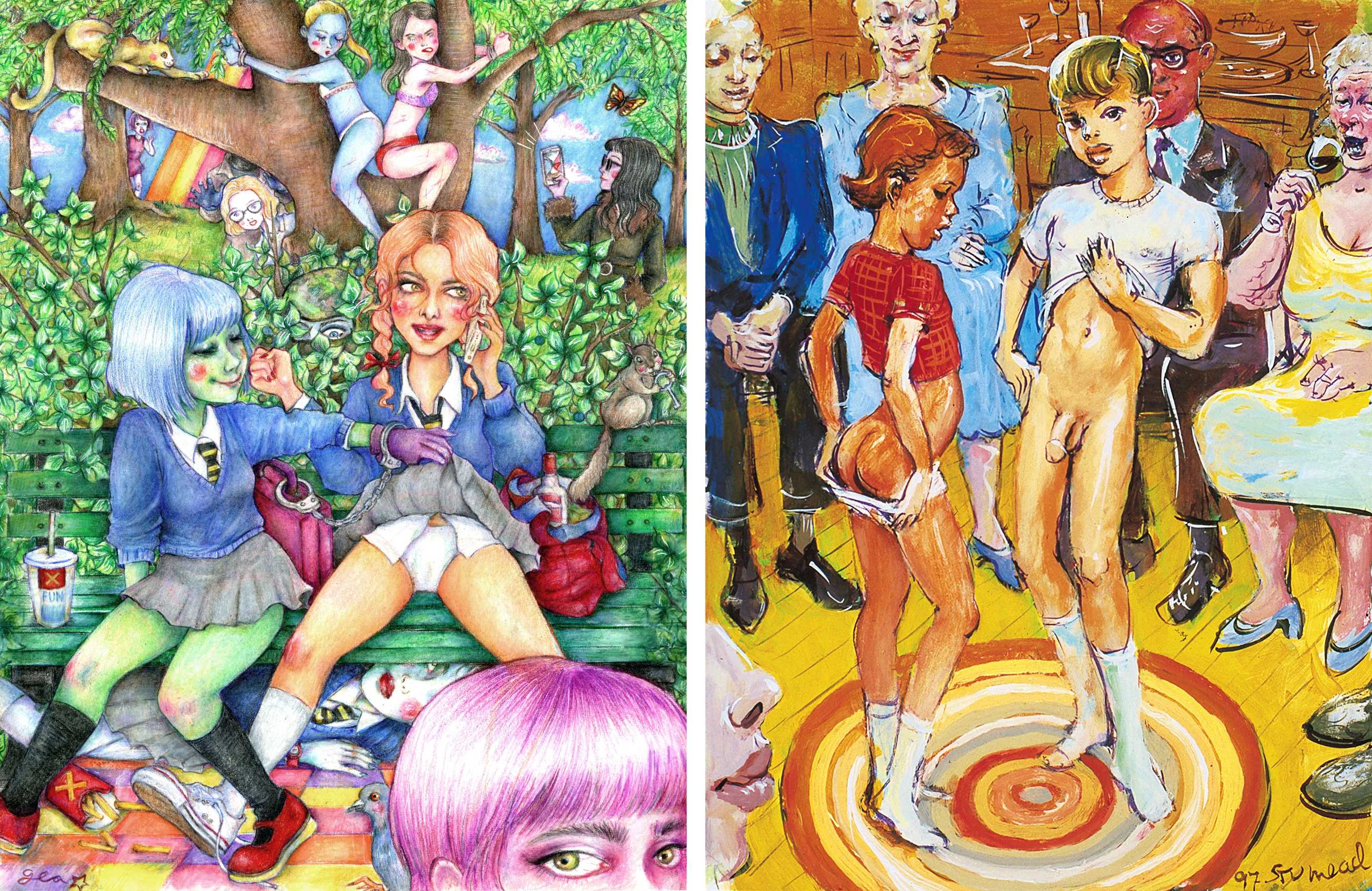 The final pair of images circles back to where we began this exploration, to children’s fascination, curiosity and embarrassment about their bodies and the strange complexity of physical existence, but now transposed into a contemporary world that many young people will readily identify with. The first is by gea*, from her 2020 series Ballad of the Tiny Girls; the second from Stu Mead’s 1999 collection Man Bag. gea*’s focus is on disturbing and explicit subject matter that juxtaposes sweetness and repulsion, often wrapped in dream-like surrealism that explores the nether regions of our collective psyche, while Mead’s work, in the words of one critic, ‘reflects a state of mock innocence and aggressive eroticism’.
While with Fini and van Maële we could approach unclothed images of childhood through familiar frameworks of fantasy, satire, historical distance and artistic convention, with gea* and Mead those protective layers are absent. gea*’s teenage girls are checking out what exposure looks and feels like; Mead’s teenagers are clearly uncomfortable in their exposure, surrounded by an adult audience. The viewer is given no guidance about how to respond to these images, and is forced to confront not only the image itself but all the assumptions and anxieties they bring to it.
This raises a fundamental tension that runs throughout all the representations of childhood we have explored – the differences between the child as experienced by the child, the child imagined by the adult artist, and the child encountered by the adult viewer. Young people may recognise aspects of their own experience, yet the images remain constructions made by adults, existing within adult frameworks of interpretation and concern. The challenge is not simply to decide whether an image is comfortable or uncomfortable, acceptable or unacceptable, but to ask what kind of encounter the artwork is creating between artist, subject and viewer.
The most challenging images are not necessarily those that seem most transgressive. In some ways the works that appear most difficult may be easier to dismiss because they trigger familiar and conventional reactions. The more demanding task is to remain attentive when an image resists easy categorisation, when it contains curiosity and unease, humour and vulnerability, familiarity and strangeness, often all at the same time. The difficult mirror not only reflects childhood back to us – it reflects our own ways of looking, and asks whether we are personally prepared to examine our responses honestly and without unnecessary self-censorship.
