 In many ways Charles-Marie-Georges Huysmans led an uneventful life, working as a civil servant at the Ministry of the Interior for thirty-two years. Yet during the last two-thirds of his government career he was also a prolific novelist. Starting out as a Zola-inspired naturalist, he became associated with the decadent movement with his publication in 1884 of the novel À rebours (Against the Grain). Huysmans found himself spurned by the naturalists, embraced by the symbolists, and associated with the career of the notorious Oscar Wilde. His work expressed his deep pessimism, which had led him to the philosophy of Arthur Schopenhauer. In later years his semi-autobiographical novels reflected his study of both satanism and Catholicism, leading to Huysman’s religious conversion and becoming an oblate in the Catholic church.
Là-Bas (Down There), published in 1891, is Huysmans’s best-known work after À rebours. Là-Bas deals with the subject of satanism in contemporary France, and the novel stirred controversy on its first appearance. It features the character Durtal, a thinly disguised portrait of the author himself, who would go on to be the protagonist of Huysmans’s subsequent novels En route (On the Path), La cathédrale (The Cathedral), and L’oblat (The Oblate).
The plot of Là-Bas concerns the novelist Durtal, who is disgusted by the emptiness and vulgarity of the modern world. He seeks relief by turning to the study of the medieval period – the first chapter includes the first critical appreciation of Matthias Grünewald’s Isenheim altarpiece – and begins to research the life of the notorious fifteenth-century child-murderer and torturer Gilles de Rais. Through his contacts in Paris, notably Dr Johannès (modelled on the Catholic priest and medievalist Joseph-Antoine Boullan), Durtal finds out that satanism is not simply a thing of the past but is alive in fin de siècle France. He embarks on an investigation of the occult underworld with the help of his lover Madame Chantelouve. The novel culminates with a description of a black mass.
Là-Bas was first published in serial form by the newspaper L’Écho de Paris, with the first instalment appearing in February 1891. It came out in book form in April of the same year. Many of L’Écho de Paris’ more conservative readers were shocked by the subject matter and urged the editor to halt the serialisation, but he ignored them. Sale of the book was prohibited from French railway stations.
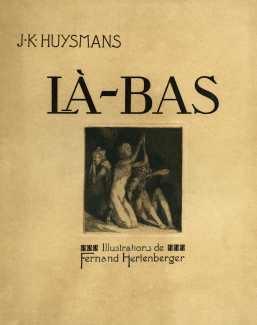
Hertenberger’s plates for this collectors’ edition of Là-Bas work in two distinct techniques, and the choice of which to use where is deliberate rather than decorative. The full-page etchings carry the book’s narrative. Built up with dense cross-hatching, they have a tonal, almost photographic depth, with candlelit interiors, crowded processions and dark landscapes. They illustrate the main events of the story – Durtal’s Paris apartment complete with cat, the historical Gilles de Rais elements with the alchemical still, the forest scenes, the execution and its aftermath, along with the crowded church interiors illustrating to the fifteenth-century thread of the plot.
By contrast, the woodcuts used sometimes as full-page illustrations but mostly as chapter headpieces, are smaller and simpler, built from bold blacks and whites rather than fine line-work. Where the etchings narrate, the woodcuts distil. Each is a single symbolic image rather than a scene – a ram’s head stares straight out of the block; a coven of skulls glows against black; a goat-horned demon rises from drapery; a figure recoils inside a web of radiating lines. The ‘radiating burst’ composition recurs at moments of supernatural or psychological intensity, Hertenberger’s visual shorthand for fear. Stylistically the woodcuts are also more modern than the etchings, with a geometric handling that owes more to 1920s book-illustration trends than to the fin-de-siècle world the novel itself belongs to.
The two techniques invest the book with real intention. It opens with a tortured crucifixion, echoing the Grünewald altarpiece Durtal contemplates in the novel’s opening chapter, and closes with the black mass itself, a horned, ram-headed officiant presiding over a prone body. The ram motif recurs across several plates, tying that final scene back to earlier woodcuts, and giving the cycle a coherence beyond straightforward chapter-by-chapter illustration.
Compared with Martin van Maële’s more explicitly erotic gouaches for the same novel, which you can see here, Hertenberger’s imagery is much more restrained. The horror is conveyed as much through symbol and atmosphere as through the direct depiction of events.
The Hertenberger-illustrated Là-Bas was published by Georges Briffaut in their Livre du Bibliophile series, in a limited numbered edition of 500 copies.