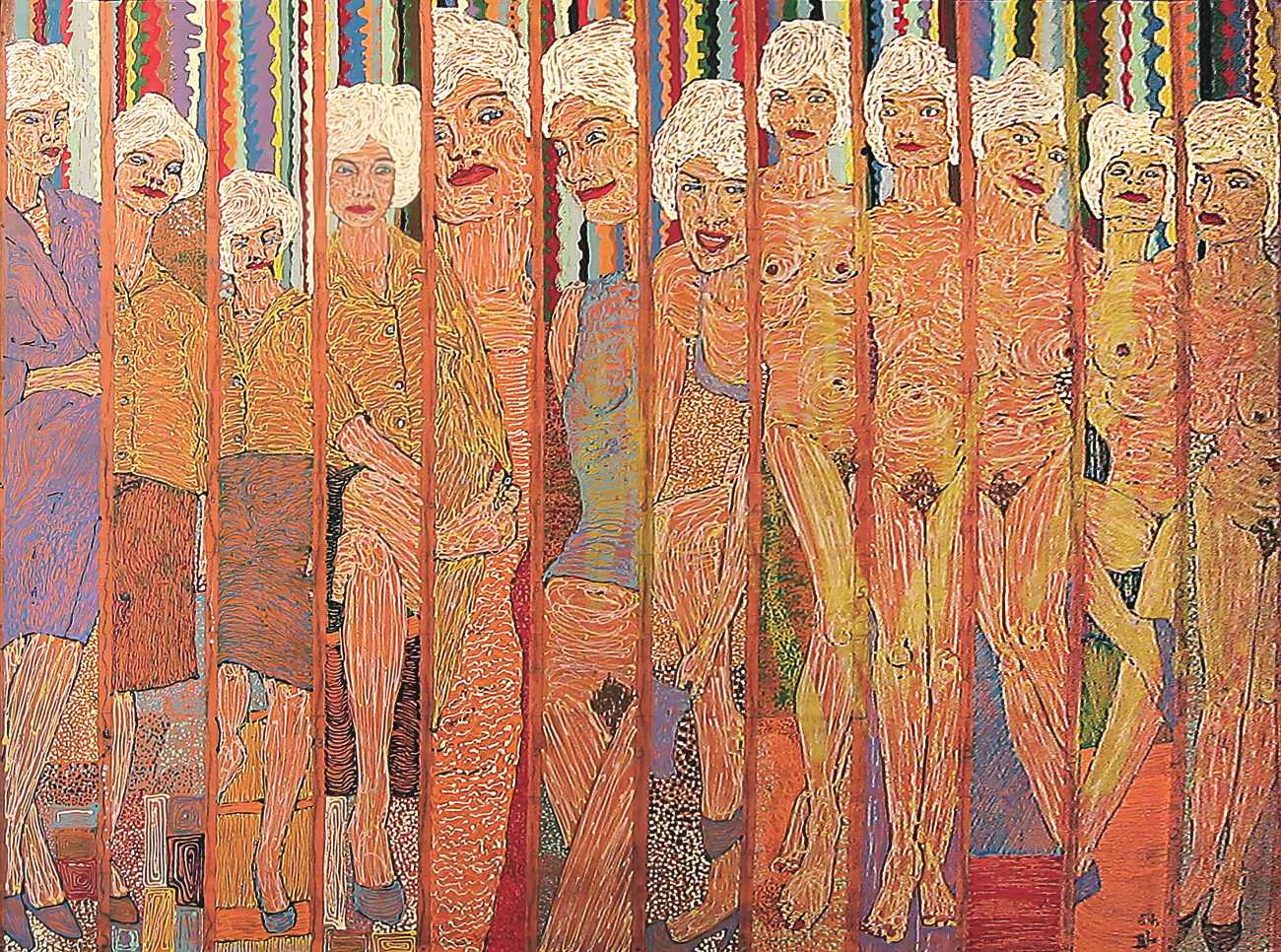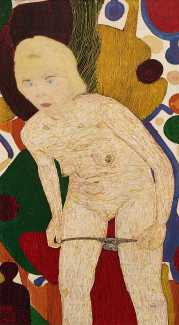
Richard Larter’s erotic drawings, paintings and collages are among the boldest produced in post-war Australia. They reject both academic idealisation and commercial glamour in favour of something far more direct – bodies presented without apology, humour without embarrassment and sexuality without euphemism.
Before moving to Australia Larter had been experimenting with painting techniques, and was inspired by seeing a box of hypodermic syringes displayed in a medical supply shop window, ‘Something like St Paul on the road to Damascus I had this vision of myself filling a syringe with paint and varying the finger pressure on the plunger, almost writing with paint.’ In Australia, however, Larter found it increasingly difficult to obtain syringes. His painting style evolved, characterised by figurative work combined with the use of linear pattern-making, collage, and experimentation with different materials. Many of his earlier works were created with thousands of looping coloured lines building flesh into vibrating surfaces that seem simultaneously anatomical and abstract, giving the body an extraordinary physical presence.
Although frequently grouped with pop artists, Larter’s erotic work followed a different path. Popular imagery – newspapers, magazines, advertising, pornography and snapshots of everyday life – provided source material that Larter transformed through his distinctive technique.
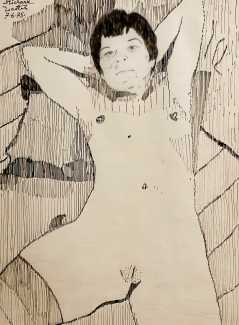
The central figure throughout much of this work is Pat Larter. Artist, performer and lifelong collaborator, Pat appears not as a passive muse but as an active participant in a shared artistic project. Her feminist performances, playful parodies of sexual stereotypes, and commitment to personal freedom became inseparable from Richard’s paintings, creating images that are both intimate portraits and wider reflections on gender, desire and power.
Larter believed that western art had become strangely embarrassed by the body, particularly female sexuality. Rather than disguising nudity behind mythology or tasteful convention, he painted the body openly, insisting that there was greater honesty in acknowledging sexuality than pretending it did not exist. For him, explicitness was never an end in itself but a challenge to censorship, hypocrisy and the uneasy relationship modern society has with erotic pleasure.
Larter’s artworks occupy an unusual position within erotic art. They are unapologetically voyeuristic, yet also self-aware; humorous, political and deeply personal. Their exuberant colour, restless surfaces and frank sexuality celebrate desire while questioning the cultural attitudes that seek to control or conceal it. More than half a century after many of them were created, they retain the power to surprise – not because they are explicit, but because they remain insistently honest.
The works in this portfolio are presented chronologically, allowing Larter’s artistic development to unfold over five decades, from the extraordinary syringe-painted nudes of the early 1960s, through the multi-panel Stripperama paintings of 1964 and the politically charged collages of the late 1960s and 1970s, to the increasingly experimental studio paintings and montages of his later years.