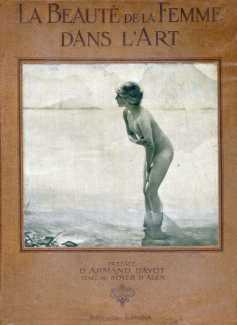
 Éditions Lapina emerged in Paris in the first decade of the twentieth century as part of the boom in finely produced illustrated books bridging the gap between elite bibliophile editions and a broader, affluent art-buying public. Closely aligned with contemporary salon culture, the firm specialised in themed portfolios that repackaged recent academic and decorative painting, often sourced from the Salon des Artistes Français, the Société Nationale, dealer archives and reproductive photograph agencies. Lapina turned them into coherent, marketable portfolios such as the female nude, childhood, or seasonal allegory. Their productions combined contextual framing by well-known figures in the art world like Armand Dayot and Boyer d’Agen, and advanced colour reproduction, typically trichrome photogravure, printed as separate plates and tipped into the volume, producing portfolios that felt both luxurious and accessible. The reign of Lapina was a short one, however, as the advent of war in 1914 put an abrupt halt to the enterprise.
Publications like La beauté de la femme dans l’art (The Beauty of Women in Art) were carefully curated selections from the late nineteenth-century salon ecosystem, in this case ‘female beauty’, using a broad range of academic, decorative, and mildly symbolist painting produced roughly between the mid-1890s and 1912. The accompanying texts lend a veneer of critical authority, but in their purple prose and lack of biographical detail they also reveal that this is salon culture reassembled and reframed for a bibliophile audience.
Selection for this portfolio was governed by a well-understood set of ‘safe’ conventions that defined acceptable nudity. ‘The nude’ itself posed no problem provided it was mediated by classical myth, allegory, pastoral backgrounds, or the neutralising setting of the artist’s studio. What is striking is not what is included but what is excluded – no overtly modern erotic situations, no intimate bourgeois interiors, and no psychologically charged or socially legible scenes of desire. Even the more sensuous images are framed as states of nature (bathers, nymphs) or abstractions (sleep, awakening), ensuring that the viewer encounters the body as an aesthetic object rather than as a participant in a narrative of sexuality. The portfolio functions as a filter, distilling from the salon system those works that satisfied both institutional taste and middle-class decorum. At the same time it is quite daring for the period, testing the edges of acceptability.
Many of the paintings are by artists who have virtually disappeared from art history, including several women, but all are still identifiable from period catalogues and archives. The works included in La beauté de la femme dans l’art are listed below.
Baigneuses surprises (Surprised Bathers) Fernand Allard l’Olivier (1883–1936)
Dans le rose (In the Pink) Ludovic Alleaume (1859–1941)
Femme nue (Naked Woman) Maurice Alexandre Berthon (1888–1914)
Nu (Nude) Louis-François Biloul (1874–1947)
Sommeil (Sleep) Ernest-Pascal Blanchard (1861–1945)
À la fontaine (At the Fountain) Pierre Bodard (1881–1937)
Les présents de la terre (The Gifts of the Earth) Henri Caro-Delvaille (1876–1928)
Réveil (Awakening) Pierre Carrier-Belleuse (1851–1932)
Matinée de septembre (September Morning) Paul Chabas (1869–1937)
Le crépuscule (Twilight) Ulpiano Checa (1860–1916)
Sommeil (Sleep) Gabriel de Cool (1854–1908)
Dans l’arène (In the Arena) Henri Courselles-Dumont (1856–1918)
Marguerite au Sabbat (Marguerite at the Witches’ Sabbath)
Pascal Dagnan-Bouveret (1852–1929)
Baigneuses (Bathers) Étienne Dinet (1861–1929)
Aïcha, la fille aux fauves (Aïcha, the Girl with Wild Beasts)
Paul-Michel Dupuy (1869–1949)
Psyché (Psyche) Adolphe Faugeron (1866–1944)
Dans la vague (In the Wave) Léon Félix (1850–1910)
La part du chef (The Leader’s Share) Consuelo Fould (1862–1927)
La nymphe de la source (The Spring Nymph) Albert Fourié (1854–1937)
Endormie (Asleep) Princesse Anina Gagarine-Stourdza (1868–1918)
La première pose (The First Pose) Massimiliano Gallelli (1863–1956)
Repos (Rest) Russell Greeley (1840–1920)
Coquette (Coquette) Henry Gsell (1858–1920)
Femme nue (Naked Woman) Gabriel Guay (1848–1923)
La mouche (The Fly) Rose Marguerite Guillaume (1871–1947)
Mon modèle et mon chien (My Model and My Dog) Gabriel Hervé (1868–1942)
Danseuse mimée de Naxos (Mime Dancer of Naxos) Hippolyte Lucas (1854–1925)
La fortune en détresse (Fortune in Distress) Gaston La Touche (1854–1913)
Suzanne (Susanna) Paul-Albert Laurens (1870–1934)
Le «Paradis perdu» (Paradise Lost) Georges Lavergne (1863–1942)
Nonchalante (Nonchalant Woman) Lucy Lee Robbins (1864–1939)
La chanson du ruisseau (The Song of the Stream)
Charles-Amable Lenoir (1860–1926)
L’heure du repos (scène d’atelier) (The Hour of Rest – Studio Scene)
Jeanne Maillart (1867–1944)
Délassement (Relaxation) Claire Maliquet (1878–1964)
La Blanche Aline (Fair Aline) Paul-Émile Mangeant (1858–1938)
Rayon de soleil (Sunbeam) Ernest-Édouard Martens (1865–1926)
Réveil (Awakening) Albert Matignon (1860–1937)
La douleur de Vénus (The Sorrow of Venus) Antonin Mercié (1845–1916)
Femme nue (Naked Woman) Richard Emil Miller (1875–1943)
Heure chaude (Hot Hour) Étienne Mondineu (1872–1940)
Femme à l’éventail (Woman with a Fan) Jean Monti (1885–1915)
Plein air – Femme nue (Outdoors – Naked Woman) Charles Moulin (1869–1960)
Biblis changée en source (Byblis Transformed into a Spring)
Armand Point (1860–1932)
Après le bain (After the Bath) André Félix Roberty (1877–1963)
Réveil (Awakening) Louis Roger (1874–1953)
La Fortune (Fortune) Gaston Casimir Saint-Pierre (1833–1916)
Femme à la statuette (Woman with a Statuette) Berthe Saizède (c.1890–1955)
Printemps (Spring) Jean Sala (1869–1918)
Sa fête (Her Celebration) Jules Scalbert (1851–1928)
Le tub (The Tub) Auguste Frederique Pierre Sezille des Essarts (1867–1950)
Farniente (Idleness) Ernest Philippe Zacharie (1849–1915)