 ‘My advice is that you should make your Pippa a whore, because the nun betrays her vows, and the married woman murders the sacrament of marriage, but the whore deceives neither monastery nor husband. Moreover she acts like the soldier, paid to do harm and who, in doing so, is not considered a criminal, because her shop sells what it has to sell; the first day an innkeeper opens his tavern without putting up a sign, one understands that one drinks there, eats there, gambles there, fucks there, blasphemes there, and cheats there, and whoever goes there to say their prayers or to fast would find neither altar nor Lent.’
Pietro Aretino’s Ragionamenti, also known as the Sei giornate (Six Days), is among the most notorious and influential works of Renaissance erotic literature. Written in two stages during the 1530s, the work combines Ragionamento della Nanna e della Antonia (Conversations between Nanna and Antonia, 1534) with Dialogo nel quale la Nanna insegna à la Pippa (Dialogue in which Nanna instructs Pippa, 1536), together forming six days of conversation structured as dialogues between prostitutes, courtesans and matchmakers. At its centre is Nanna’s attempt to determine the future of her daughter Pippa. The possibilities considered – convent life, marriage or prostitution – become the basis for an unsparing critique of female existence in sixteenth-century Italy. Aretino presents each social role not as an ideal but as a system of exploitation. The convent emerges as a site of hypocrisy and sexual corruption, marriage as economic dependence and domestic tyranny, and prostitution, paradoxically, as the only condition in which a woman may exercise a degree of autonomy and social agency.
The work’s scandalous reputation rests not merely on its explicit sexual content, but also on its coldly pragmatic moral logic. Nanna ultimately concludes that prostitution is preferable because it openly acknowledges the transactional nature of desire rather than concealing it beneath religious or matrimonial ideals. Throughout the dialogues, sexuality is treated economically rather than sentimentally. Affection becomes a mechanism of negotiation, manipulation and survival. In the later sections, Nanna instructs Pippa in the practical arts of seduction, emotional control and financial self-preservation, warning above all against falling genuinely in love with men. Aretino overturns the conventions of renaissance courtly literature by rejecting the idealisation of love associated with Petrarchan tradition. Instead he presents human relationships as fundamentally governed by appetite, money and power. The result is both comic and deeply cynical, but also strikingly modern in its psychological realism.
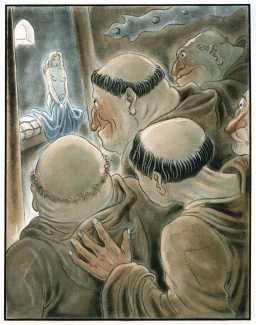 André Collot's plates work through the dialogues with a range of imagery that shifts deliberately from comic to violent. The religious episodes give him his most characteristic effects – a nun stripped to her stockings and led by a troupe of giggling putti through a Gothic interior; a fallen sister upended among scattered grapes and overturned glasses; a chapter of tonsured friars eyeing a half-clothed novice with clear lust. The contrast between idealised young women, fine-boned and pale, set against grotesque male caricatures with hooked noses, jowls and bald pates is a familiar device, and Collot makes it his own through draughtsmanship rather than crudity.
The wife and courtesan dialogues bring out darker themes. One plate shows a young woman dead on a bed, a sword driven through her mouth; another a bleeding woman watching her assailant flee through a doorway. These are handled with the same decorative composure as the bedroom scenes, and the effect is genuinely disquieting, Aretino's mordant comedy taken at its word.
The plates are colour copper engravings, with the etched line carrying the drawing and the colour sitting over it, giving skin and drapery their powdery surface. The drapery creates much of the setting, with heavy curtains, tumbled sheets and theatrical hangings turning each scene into a tableau, often accompanied by still-life detail – fruit bowls, candlesticks, jewellery, wicker-bound flasks.
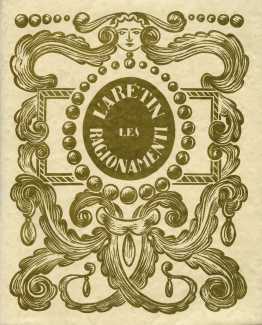
The Collot-illustrated Les ragionamenti was published in four volumes by Le Vasseur, Paris, in a limited, numbered and boxed edition of 485 copies.