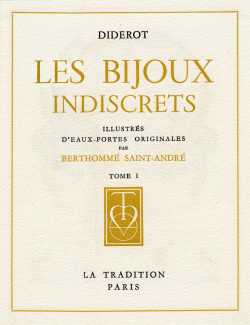
 Denis Diderot’s Les bijoux indiscrets (The Indiscreet Jewels), first published anonymously in 1748, occupies a curious place in the literature of the French enlightenment, at once a libertine fantasy, a political satire, an experimental novel, and an early exercise in philosophical irony. Written before Diderot became famous as the co-editor of the Encyclopédie, the book belongs to the exuberant and often scandalous culture of mid-eighteenth-century French fiction, when oriental settings, sexual intrigue and thinly veiled commentary on court life provided writers with a degree of protective disguise. Although ostensibly set in the fictional African kingdom of Congo, the novel is transparently aimed at the society of Louis XV and the habits of the French aristocracy. Like many libertine texts of the period, it uses erotic comedy not simply for titillation but as a mechanism for exposing vanity, hypocrisy and the instability of social appearances.
The premise is famously absurd and deliberately provocative. Sultan Mangogul, bored with the superficial manners and intrigues of his court, receives from the genie Cucufa a magical ring that compels women’s ‘bijoux’, a euphemism for their genitals, to speak aloud and reveal the truth about their sexual histories and desires. Mangogul proceeds to test the ring on a succession of court ladies, whose bodies betray what their polite conversation conceals. The resulting confessions range from comic and grotesque to sentimental and unexpectedly reflective.
Narratively, the novel is strikingly modern in places. Diderot constantly interrupts the flow of the story with digressions, mock-philosophical discussions and abrupt tonal shifts. The narrator comments on the act of storytelling itself, toys with the reader’s expectations, and treats the novel form as something elastic and experimental rather than fixed. This self-consciousness anticipates aspects of Diderot’s later fiction, particularly Jacques le fataliste, where narrative interruption and conversational instability become central techniques. In Les bijoux indiscrets, however, these devices remain intertwined with the libertine mode. Diderot alternates between bawdy farce and genuine intellectual curiosity, especially in passages touching on sensation, desire and the relationship between body and mind. Beneath the playful obscenity lies an enlightenment fascination with truth-telling – the magical turns hidden impulses into speech, turning sexuality into a form of involuntary confession.
The publication history of the work reflects both its popularity and its ambiguous status. Printed anonymously in 1748, probably with tacit Dutch involvement typical of clandestine French publishing, the novel circulated quickly. Diderot himself later regarded some of the book as immature or excessively frivolous, and it never achieved the philosophical prestige attached to his later writings. Nevertheless, it remained widely read, partly because of its scandalous premise and partly because readers recognised the sharpness of its social observation.
Berthomme Saint-André’s coloured etchings for this edition of Les bijoux indiscrets show him at the height of his illustrative powers; he clearly appreciated both the narrative and Diderot’s devices and sentiments to produce one of the best suites of illustrations to accompany this classic of enlightenment erotic parody.
Les bijoux indiscrets was published in two volumes by La Tradition, Paris, in a limited, numbered and boxed edition of 450 copies.
An excellent translation by Sophie Hawkes of Les bijoux indiscrets has been published as The Indiscreet Jewels by Marsilio Classics. This edition also includes a comprehensive historical and literary introduction to the work and its author by Aram Vartanian.