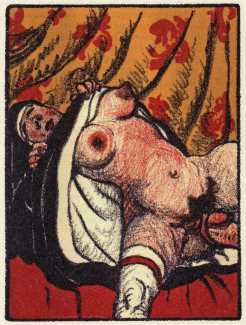
 The excuse for this witty, explicit series of colour illustrations of cavorting friars and nuns is a German edition of Pietro Aretino’s opening dialogue from his Ragionamento della Nanna e della Antonia (Conversations between Nanna and Antonia) from 1534, a lively conversation between the ageing courtesan Nanna and her friend Antonia. As Nanna considers the future of her young daughter Philippa, she weighs the three traditional paths open to women – nun, wife, or courtesan. Antonia assumes that the convent offers the safest and most virtuous life. Nanna's response is a long, witty demolition of that belief.
Rather than presenting convents as places of piety and self-denial, Aretino depicts them as intensely human communities in which desire, ambition, jealousy and intrigue flourish behind the cloister walls. Through a succession of increasingly outrageous anecdotes, Nanna describes nuns conducting clandestine affairs with priests, friars, servants and noblemen, while ingenious devices and secret passages facilitate forbidden encounters. Abbesses enforce discipline when it suits them, but are often as compromised as those they govern. The humour lies in the relentless accumulation of stories, each more extravagant than the last, punctuated by Antonia's repeated expressions of disbelief.
Die sündigen Klosterschwestern (The Sinful Nuns) inevitably emphasises the sexual aspects of Aretino’s dialogue, unfairly placing all the sinfulness on the deflowered sisters rather than the massively-endowed, leering friars. The bold plates are very much in the German expressionist graphic idiom, printed as lithographic black with pochoir colours added. If we had to guess at the artist, one of the Simplicissimus illustrators such as Olaf Gulbransson or Bruno Paul comes to mind, though as far as we can tell Die sündigen Klosterschwestern is in a class of its own.
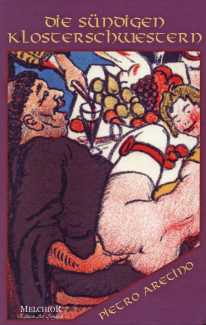 In 2009 the German publisher Melchior Verlag produced a version of Die sündigen Klosterschwestern in their Edition Ars Amandi series, with all the colour illustrations and a translation of the Aretino text – the text and illustrations are tastefully done, the 1970s-style cover rather a letdown.