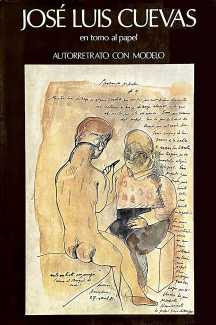
 It was in his grandfather's paper mill that Cuevas first discovered the fascination of drawing, but for many years the paper he could afford was of poor quality. Even after he began selling his work he remained reluctant to use expensive drawing papers, fearing that unsuccessful attempts would spoil the surface and end up in the waste bin. When wealthier collectors presented him with fine European papers, he often found them too precious to use.
By the early 1980s his reputation had become firmly established, allowing him to buy better-quality materials, including sample books of drawing papers from leading French and Spanish paper-makers. Autorretrato con Modelo (Self-Portrait with Model) makes use of pages from one such sample book to create an intensely personal record of his encounters with the professional models he could now afford to employ regularly.
The series comprises two sections: eighty-three drawings accompanied only by brief notes, and twenty-two drawings that incorporate an autobiographical journal in which Cuevas records the thoughts and emotions prompted by each image. The first eleven drawings in the second section each acknowledge a particular artistic or literary influence: Modigliani, Picasso, Byron, Casanova, Goya, Rembrandt, Ingres, Van Gogh, Sade, Bellmer and Cézanne. Note that the white cut-outs on many of the sheets are a feature of the sample books, around which Cuevas frames his images.
Taken as a whole, Autorretrato con Modelo offers a rare insight into an artist’s relationship with the model, both on a professional level and – which is very rarely explored – on a psychological level.
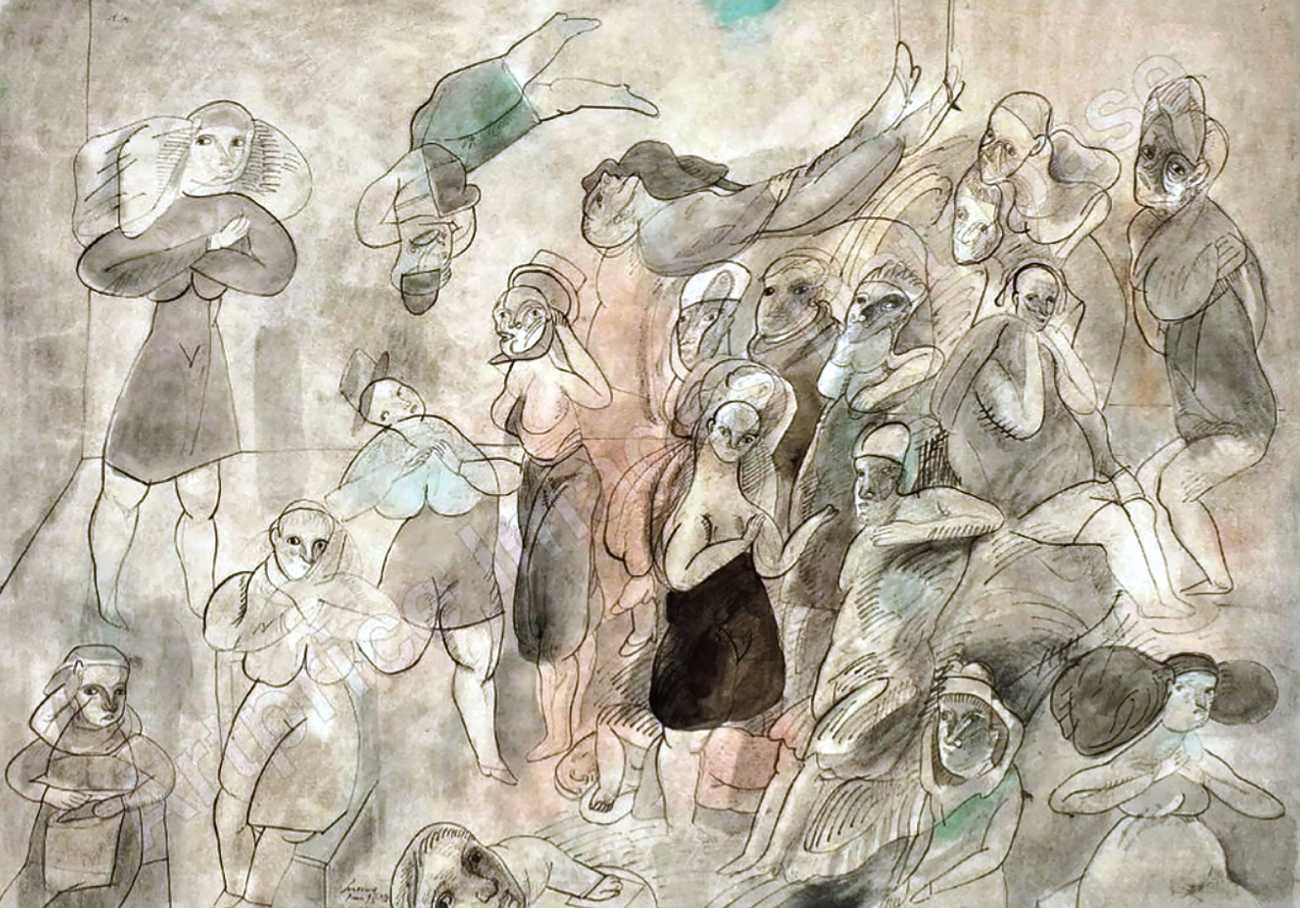
The volume presenting the portfolio includes an extensive introduction by José Gómez-Sicre, Curator of the Museum of Contemporary Art of the Latin American Organization of American States in Washington. We reproduce an extract below. Autorretrato con Modelo was published in both Spanish and English by Ediciones Polígrafa.
Any drawing by Cuevas, especially those on a larger scale, has all the impressiveness of a work done on much more durable material than paper. In his hands, moreover, the paper becomes transformed into a document with aspirations to eternity, as an intrinsic work of art, something just as valuable as the most enduring or luxurious of materials. Besides, it is absolutely timeless. I have always said that the ancestry of his art goes back to Hieronymus Bosch, through Rembrandt, Brueghel and Grunewald, as if to show that he has lingered at every stage of expressionism in the history of art. Sometimes, when he decides to curb this expressionism, his hand is attracted to the serenity of the Italian renaissance masters. He then produces little gems that might have been signed by Leonardo, Raphael, Mantegna or any other of the great artists who offered him an example to follow whenever doubts or temperament led him to change his course. But I certainly do not wish to imply that Cuevas is simply a sponge for other artists’ influences, a living lesson of art history.
In these hundred and five drawings, poured on to the paper like gifts from some particularly lavish horn of plenty, we can see the legitimacy of the painter’s own expressionism, valid precisely because it neither disowns its origins nor conceals its various starting points. At his present stage of development, the maturity of a personality universally admired, he has not only thoroughly assimilated the lessons of the past and thereby enriched his creative potential, but has also continued absorbing attitudes and styles: for we find Goya and Picasso too, as evidence of the Spanish heritage working in this Mexican artist who has attained such celebrity.
The most important feature of his work, after the influence of all the great names from the remote and recent past, is the insertion of the perpetual values of the aboriginal art of his own people – the archaic, hieratic strength of pre-Columbian sculpture, with its unshakable solemnity and unerring interplay of volumes from which Cuevas’ most recent work takes its strange solidity. When Cuevas draws a volume it gives the impression of flint, a dense, weighty mass described by his line with its variant values. Some of his imitators, copying the external, produce an idea of inflation and air. Where Cuevas in his line holds flesh or granite, the others trace globes of frail skin that can be inflated or deflated, flabby bladders that might at most sail a few yards in the air. Cuevas’ volumes do not rise; they remain in thrall to the law of gravity and rest on the ground, with a weight similar to that of pyramids, sphinxes or tanks, all made by man, or even rolling hills or mountains, made by god. Even when the line becomes nimble and restless, and a figure rises, dances or climbs, the volumes neither become hollow nor escape into the air.
This series, without tedious repetitions, only consists of a female model and a self-portrait. In their evolution both characters change in aspect but not in physiognomy. They are the artist’s plastic children, constantly adopting varying expressions and poses, and accepting the most daring differences in the technique within which he conceives them. The really important factor, the line, is an instrument of purity that few contemporary artists can use so lavishly without ever for a moment losing an atom of its dash.
Since the two characters that are the basis for this series of drawings bear no message and have no literary content whatsoever, on this occasion – as on others when he has been confronted with a theme – Cuevas does not illustrate, does not narrate, does not tell any stories; he simply draws his theme and immortalises it as drawing, without attempting to go beyond its significance, an aesthetic value that will always be the motive power of his work.
It is thanks to the paper sample-book and this protean couple that this portfolio has been conceived and has taken shape, to become yet another living being in this repertoire of desolate humanity that Cuevas has always endeavoured to present.