In the winter of 2018–19 the Louisiana Museum of Modern Art in Humlebæk, Denmark, held an extensive exhibition of Cecily Brown’s art. The defining painting of the exhibition was the ten-metre long Where, When, How Often and With Whom, which gave the exhibition and accompanying catalogue its title. The frieze-like composition features bodies weaving in and out of a turbulent background. It is hard to create a coherent narrative out of the actions and interactions, but there are some suggestions – on the left, a group of figures float over a masted boat, then a group of women behind a spread blanket, two female figures shielding each other as they head out of the picture, and finally what could be a lifeless body with a woman kneeling beside it. Is the painting telling a story, is it mirroring a biography? All we have is the title, which is as intriguing, enigmatic and all-embracing as much of Brown’s work. In our sexualised and euphemised world Where, When, How Often and With Whom would usually be understood as a question about a person’s sex life, but here it has no question mark, leaving the viewer with the unanswered question ‘What?’ Which is probably exactly what Cecily Brown would like to leave us with – ‘What is this painting about for you, and what do you imagine it was about for me?’
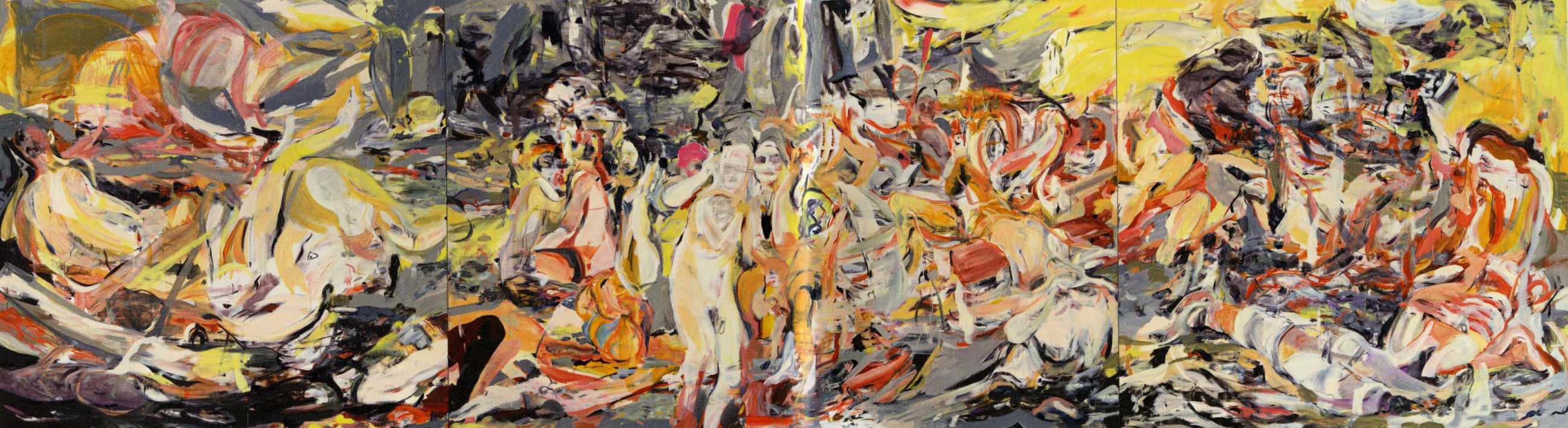
Although Brown does not usually begin by talking about eroticism, bodies, intimacy and desire in her work, they recur so frequently that they become impossible to ignore. In interviews she more often speaks about painting itself: the physical act of making it, the continual dialogue between abstraction and figuration, and the long conversation she conducts with artists from Rubens and Bosch to Degas and de Kooning. Rather than treating eroticism as a subject, Brown absorbs it into the language of paint itself.
This is not to say that she dismisses the role of sexuality in her work. Asked by fellow artist Lari Pittman how she understood the ‘sexual’ and the ‘sexy’ in her work, she replied ‘I suppose you could say that the sexual is in every painting, whether there is an overt subject or not. The tension within the painting, whatever the subject, is the desired outcome.’ This distinction is important. For Brown, sexuality is not simply a matter of naked figures or erotic subject matter; it resides in the dynamic tension of the painting itself. Her paintings occupy the shifting ground where bodies emerge from paint only to dissolve back into it. Figures are rarely fixed or fully described, limbs blur into brushstrokes, flesh becomes landscape, and one body flows into another. Looking at a Cecily Brown painting can feel like remembering a dream or catching sight of lovers through foliage.
Brown often describes painting as an intensely physical act. ‘It’s a marriage of your brain and your body,’ she says, adding that over the years, she has come to believe painting is closest to dance and poetry. That observation offers an important key to her work – her paintings are physical not so much because they depict naked bodies, but because they are a record of the gestures and rhythms that went into their making.
Although Brown’s paintings often appear spontaneous, they are anything but impulsive. She works on numerous canvases simultaneously, allowing them to develop over months or even years. She paints quickly but revises relentlessly, responding to what each canvas demands rather than imposing a predetermined design. As Brown herself puts it, ‘I don’t finish, I just stop.’ The result is work that retains a sense of discovery, with artist and viewer engaged in a shared process of searching.
Art history provides Cecily Brown with an inexhaustible source of imagery. Rubens, Bosch, Hogarth, Bruegel, Degas and countless others supply a cast of recurring characters who migrate from one painting to another, changing their roles as they go. Brown has likened them to actors performing different parts, an analogy that explains why her paintings often feel both familiar and strange. Her titles reveal another side of her imagination, many borrowed from old Hollywood musicals, songs or plays because, as she explains, they are ‘like a Busby Berkeley song and dance routine, maybe with a hand grenade thrown into it.’
One of Brown’s principal subjects is conflict, the dichotomy of good and evil existing in the same place at the same time. Her naked bodies are sites of pleasure and vulnerability, attraction and violence, intimacy and isolation. Even her landscapes seem inhabited by flesh, bodies dissolving into leaves, water and sky. Desire is present throughout, but it is inseparable from the broader complexities of being human.
When discussing her paintings with fellow artists and curators she speaks of movement, conflict, colour, history and process; when asked directly about sexuality she is equally clear that ‘the sexual is in every painting’. These are not competing interpretations but different ways of approaching the same paintings. Again and again Brown returns to naked bodies, embraces, bathers and lovers, reminding us that eroticism need not depend upon explicit sexual imagery – it can reside equally in gesture, touch and ambiguity. In Cecily Brown’s work the sensuality of the subject and the sensuality of the painting are indivisible.
In this selection of her work we start with earlier, more figurative drawings and sketches, then move through more clearly figurative work with identifiable subjects, and on to her large, colourful paintings with titles like The Baptism, Thug in Landscape, and The Green Green Grass of Home.