
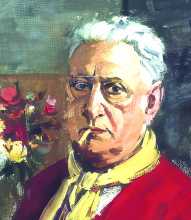
 The French artist Constant Le Breton grew up in Saint-Germain-des-Prés, near Angers in western France. He was descended from a modest family of Loire riverboatmen, and his early artistic ambitions were shaped as much by necessity as by talent. After first entering apprenticeships in Nantes and later in Le Mans, he was admitted to the École des Arts Décoratifs in Paris, an important step for any aspiring artist of the period, but financial hardship prevented him from taking up his studies, and his parents instead found him practical work with a painter of shop fronts, and he later continued as a decorator in Le Mans. These years of artisanal labour gave him a strong grounding in craftsmanship that would remain evident throughout his career.
The outbreak of the first world war saw him mobilised in 1915, serving in the Dardanelles campaign and later in the eastern theatres of the war. Like many artists of his generation, the experience left a lasting impression on him. After the Armistice he settled permanently in Paris, where he initially worked with the Amoroso brothers, noted theatre decorators. Before long, however, he turned increasingly towards wood engraving, a medium in which he quickly earned a solid reputation. His illustrations for books attracted particular praise and helped establish his name within Parisian artistic circles.
Recognition came early. The Blumenthal Foundation awarded him a grant of 12,000 francs in acknowledgement of his wartime drawings, a significant distinction that enabled him to devote himself more fully to painting. During the interwar years he became closely associated with a wide network of painters, sculptors and writers. Among his friends and acquaintances were older artists such as Maximilien Luce, André Derain and André Dunoyer de Segonzac.
Le Breton became particularly admired as a portrait painter. Among those he painted were the novelist Alphonse de Chateaubriant, the actor and theatre director Charles Dullin, the actress Ingrid Bergman, the Comédie-Française performer Béatrice Bretty, the writer Maurice Genevoix and the physician and man of letters Henri Mondor. He also portrayed members of the aristocracy, including the Countess of Chabrignac, as well as fellow artists such as Maximilien Luce and André Derain.
In 1926 Le Breton and his wife Fernande moved with their children to 21 rue Visconti, in the sixth arrondissement of Paris, where they occupied a small house tucked away at the rear of the courtyard, and this modest address would remain his home for the rest of his life. In 1937 his friend the poster designer Cassandre (the pseudonym of Adolphe Jean-Marie Mouron) offered him the rental of a studio at number 19 on the same street, thus cementing his artistic life in the quiet enclave of rue Visconti, long associated with painters, writers and publishers.
A website devoted to the life and work of Constant Le Breton can be found here.
Similar artists
Paul-Émile Bécat – French illustrator of refined erotic fine editions.
Jean Berque – French interwar bibliophile illustrator of a similar sensual tone.
André Collot – French illustrator of refined erotic editions in the period.
Léon Courbouleix – French illustrator of clandestine erotic and bibliophile editions.
Jean-Gabriel Daragnès – French engraver, printer and illustrator of fine editions.
Jean Dulac – French interwar bibliophile illustrator for the fine-press market.
Sylvain Sauvage – French art deco illustrator of refined livre d’artiste editions.
Example illustration

Gamiani (1925)


