
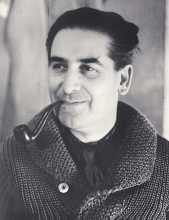
 Gustave Louis Buchet was a Swiss painter whose career was shaped by the artistic ferment of Paris between the two world wars. He grew up in Etoy, on the north shore of Lake Geneva, in a family deeply rooted in the local community – his father Auguste was a schoolteacher and amateur painter who founded the institution that would later become L’Institution de l’Espérance, a specialised centre for people with disabilities. After studying at the École des Beaux-Arts in Geneva, Buchet travelled to Paris in 1910 with fellow Swiss artist Rodolphe Théophile Bosshard. Returning to Switzerland, he helped found the Falot Group in 1915 with Maurice Barraud and other young artists who sought an alternative to the dominant influence of Ferdinand Hodler and his monumental symbolism, and looked instead towards the artistic innovations emerging from Paris. During a further stay in the French capital in 1916–17, Buchet encountered figures including the artist Jeanne Hébuterne and the sculptor Ossip Zadkine, while friendships with Alexander Archipenko, Fernand Léger and the purist circle around Le Corbusier placed him in direct contact with some of the most influential currents of European modernism.
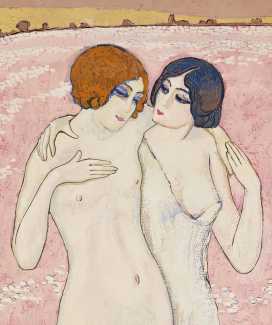
Buchet’s artistic development followed a succession of modern movements. Initially attracted to futurism, he later participated in the dada movement. He settled in Paris in 1920, and exhibited with the Section d’Or in Paris, Amsterdam and Brussels. His work in the 1920s reveals a highly personal synthesis of post-cubism, when rigorously structured compositions, flattened forms and strong colour became hallmarks of his mature style. Alongside painting he worked in illustration, sculpture, theatre and costume design, exhibiting at venues including the Salon des Indépendants and participating in the influential 1925 exhibition L’Art d’Aujourd’hui.
From the early 1930s Buchet gradually returned to a more traditional figurative manner. Forced back to Switzerland in 1939, he settled in Lausanne, where he remained active as a painter and designer, contributing to the first Salon de Printemps in 1941, creating décor for the Zurich cabaret Au Coup de Soleil, and later designing mosaics for Lausanne’s fire station. A retrospective at the Cantonal Museum of Fine Arts in 1958 recognised his achievements, although his avant-garde work was not fully rediscovered until after his death. Today Buchet is regarded as one of the most distinctive Swiss modernists of his generation, a painter who absorbed the lessons of cubism, futurism and purism while maintaining a strongly individual artistic voice.
Similar artists
Umberto Brunelleschi – Paris pochoir master of the same interwar decade; a shared art deco decorative idiom.
Frans de Geetere – A Paris modernist of the same decade, with a graphic directness that echoes Buchet’s.
Armand Lobel-Riche – Leading French erotic drypoint engraver; the intaglio tradition in which Buchet’s plates were made.
Jeanne Mammen – Modernist sapphic imagery in a parallel graphic language; Berlin counterpart to Buchet’s Paris.
Sylvain Sauvage – Art deco book artist and illustrator in the same Paris erotic publishing orbit.
Example illustration

Les amies – Filles (1921)


