
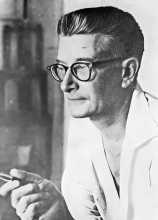
 The French painter, illustrator, interior decorator and novelist Pierre Adrien Ekman grew up in Moisson, on the banks of the River Seine north-west of Paris. He entered the world under tragic circumstances – his father, the businessman Pehr Gustaf Ekman, had been killed several months earlier in a railway-crossing accident, an incident that also claimed the life of Ekman’s older brother. Through his mother’s relations Ekman belonged to a cultivated artistic milieu connected to the painter Allan Österlind, and although little is known about his formal training by the late 1920s he had already established himself within Parisian artistic and decorative circles.
Ekman first attracted attention as an illustrator and decorative painter during the final years of the art deco era. In 1928 he contributed a lithograph to the celebrated tricentenary edition of Contes de Perrault, the famous Édition des 33 graveurs, alongside many of the leading illustrators and printmakers of the period. Two years later he appeared in the exhibition of decorators and book illustrators at the Cercle de la Librairie in Paris. He married the painter Rosalie Anna Fontan, known as Suzanne Fontan, who would become one of the signature artists of Maison Nobilis from 1939 onwards, designing many of the romantic floral wallpapers and printed fabrics for which the firm became internationally known. Although Ekman’s reputation never became widely public, fellow decorators and collectors recognised in him an artist of unusual imagination whose style combined elegance, fantasy and technical sophistication.
As a decorator, Ekman specialised in richly atmospheric interiors that fused illusionistic painting with the luxurious craftsmanship associated with art deco and post-war decorative design. His painted panels, scenic wall decorations and trompe-l’œil effects often featured dreamlike Mediterranean landscapes, classical ruins and theatrical architectural fantasies that invited comparison with the surreal imagery of Salvador Dalí. During the 1930s and 1940s he collaborated with some of the leading names in French interior decoration, including René Prou, René Drouet, Jean Dunand and Jules Leleu.
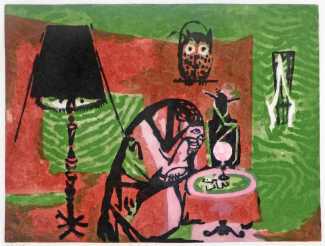
Alongside his decorative work, Ekman was also an illustrator and writer. He continued to produce book illustrations after the second world war, notably for a 1947 edition of Les pièces condamnées (The Condemned Poems) by Charles Baudelaire. From the mid-1950s he increasingly devoted himself to writing fiction, publishing a sequence of atmospheric novels set in Mediterranean or tropical landscapes. Drawing on his earlier years as a sailor, his travels in South America, and his friendship with the explorer Edgar Maufrais, these novels share with his visual work the same taste for sensual atmosphere, exotic settings and psychological tension.
A retrospective tribute to his work, Ekman: Décors, was held at the Musée Denon in Chalon-sur-Saône in 1975. He spent his later years in the south of France, and even in old age he remained professionally active – in 1983 he was entrusted with the restoration of the 1526 frescoes signed by Andrea de Cella in the chapel of Notre-Dame del Bosc, on the path leading up to La Roquette-sur-Var in Alpes-Maritimes.
Similar artists
Pierre Combet-Descombes – French fauvist painter, another illustrator of Baudelaire's poetry in the same period.
Leonor Fini – French surrealist artist of dreamlike, classically staged erotic scenes.
Alméry Lobel-Riche – French illustrator and etcher who also illustrated Baudelaire's poetry.
Armand Rassenfosse – Belgian printmaker who also illustrated Baudelaire's poems.
Pavel Tchelitchev – Russian-American neo-romantic designer of dreamlike, elaborately staged figurative fantasies.
Example illustration

Les pièces condamnées (1947)


