
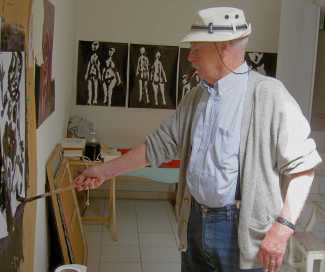
 The French painter, graphic designer, illustrator and artistic director Jacques Daniel grew up in Les Andelys in the Eure département of Normandy, and trained in Paris from 1935 at the École Estienne (École des Arts Appliqués), also attending the Académie de la Grande Chaumière in Montparnasse, qualifying as a lettering painter.
In 1937 he met the collector and critic Wilhelm Uhde, a decisive early influence, who introduced him to artists including Louis Vivin, Camille Bombois, Séraphine de Senlis and Georges Braque. Daniel began painting in oils at this time, and by 1938 he was already employed as a layout artist in publishing.
During the second world war he joined the resistance, becoming a member of a Francs-Tireurs et Partisans group. Working professionally as a model-maker and layout artist, he specialised in the production of forged identity papers.
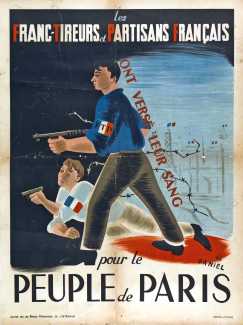 Jacques Daniel’s activity in the resistance culminated in August 1944 during the Paris uprising, when, with his younger brother Michel, he took over a printing works on the rue de Charonne and produced a poster on behalf of the Forces Françaises de l’Intérieur. The poster depicts an armed member of the FTP advancing past a wounded comrade, with the inscription ‘Les Francs-Tireurs et Partisans Français ont versé leur sang pour le peuple de Paris’ (The Francs-Tireurs et Partisans Français shed their blood for the people of Paris). Combining a direct political message with a carefully structured composition incorporating the colours of the French flag, barbed wire, and a stylised Parisian backdrop, it stands as both a call to insurrection and as an early example of Daniel’s ability to integrate pictorial and typographic elements under difficult conditions.
After the war Daniel resumed painting and reconnected with Uhde, who acquired several of his works. By 1949 he was exhibiting in the Hommage à Wilhelm Uhde exhibition at the Galerie Denise René, alongside major figures including Pablo Picasso and Georges Braque. His first solo exhibition followed in Paris in 1950 at the Galerie Palme, with subsequent solo and group exhibitions throughout the 1950s and 1960s in Paris, Liège, Brussels, Cannes and Belgium. He continued to exhibit regularly into the 1970s, with a retrospective at the Musée de Saint-Omer in 1970 and further shows in Paris and abroad.
Parallel to his activity as a painter, Daniel developed a substantial career in graphic design, typography and book production. Under the influence of Pierre Faucheux, he joined the Club Français du Livre, where he worked as an artistic director and layout designer from 1957 to 1970. He contributed designs and illustrations to numerous editions, including Alexandre Dumas’s Les trois mousquetaires (The Three Musketeers, 1960), Louis Pergaud’s La guerre des boutons (The War of the Buttons, 1962), and Pierre Louÿs’ Les aventures du Roi Pausole (The Adventures of King Pausole, 1962) and Les chansons de Bilitis (The Songs of Bilitis, 1963). He also produced work for the Crime-Club series published by Éditions Denoël.
 Daniel was also active in editorial design, contributing to or redesigning layouts for periodicals such as La Quinzaine Littéraire and Cahiers du Cinéma. He was regarded as one of the four leading French typographers of his generation, alongside Jacques Darche, Pierre Faucheux and Robert Massin, and wrote on questions of modern graphic design, including participation in the collective volume La créativité en noir et blanc (Creativity in Black and White, 1973).
In 1966, in collaboration with Étienne Thil of Carrefour, Daniel designed the company’s new logo, based on opposing arrows forming a central C, a design that is still in use.
Similar artists
Zevi Blum – American etcher and illustrator of erotic literary classics.
Édouard Chimot – French art-deco illustrator of Pierre Louÿs and other erotic editions.
Serge Czerefkov – Russian-French émigré illustrator of Pierre Louÿs’s Aphrodite.
Daniel Girard – French illustrator who also illustrated Louÿs’s Roi Pausole.
Georges Pichard – French pioneer of adult-comics adaptations of erotic literary classics.
Example illustration


