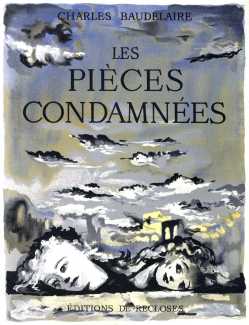
 Ekman’s portfolio for Charles Baudelaire’s Les pièces condamnées (The Condemned Poems) arrived at a charged moment. The six poems removed by court order from the 1857 Les fleurs du mal (The Flowers of Evil) were still legally proscribed, and would only be rehabilitated by the Cour de Cassation in May 1949. To illustrate them in 1947 was to anticipate – perhaps to nudge – that rehabilitation. The edition is not strictly limited to the six condemned poems – it opens with Au lecteur (To The Reader) and the Épigraphe pour un livre condamné (Epigraph for a Doomed Book), which frame the cycle and underline the collection as an integrated dark sequence rather than just a miscellany.
Stylistically the suite sits at the meeting point of two traditions – the decorative surrealism that ran through 1930s Paris in the work of Giorgio de Chirico, Pavel Tchelitchew and Eugene Berman, with drawn-back curtains, broken classical heads and obelisks against troubled skies – and something darker and older, owing much to Francisco Goya. The Goya influence is particularly noticeable in the plates depicting a hooded figure cradling a swooning woman above a fallen mask, a colossal pale head erupting with writhing bodies, and the swirl of disembodied hands wielding daggers and torches.
Very few French illustrators of the period treated Les pièces condamnées as a self-contained cycle rather than including them in a complete Les fleurs du mal. Ekman's choice to treat the six condemned poems as a stand-alone cycle shows that he saw them as a dark and integrated series with its own internal logic. He populates the cycle with vampires, hooded figures, sleeping victims and masks half-buried in sand, staging them with the eye of the theatrical decorator he was by trade. The novelist who would emerge from the mid-1950s, with his taste for Mediterranean atmosphere and psychological menace, is already present in these powerful images.
Les pièces condamnées was published by Éditions de Recloses, in a limited numbered edition of 2,980 copies.