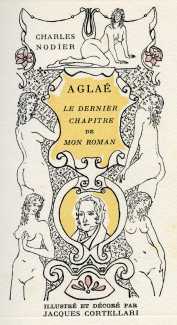
 Charles Nodier (1780–1844), now best remembered as the librarian of the Bibliothèque de l’Arsenal and the host of the Cénacle that included Victor Hugo, Gérard de Nerval and Sainte-Beuve, published Le dernier chapitre de mon roman (The Last Chapter of My Novel) anonymously in 1803, at the age of twenty-three, and very different from the romantic conte fantastique with which he would later make his name. The text is short, anti-novelistic, indeed barely a novel at all, more a Sternean experiment in which Aglaé, she of the title of this volume, exists only as the implied object of a love story the narrator cannot bring himself to finish. It was promptly forgotten before being revived once in Léon Conquet's luxurious 1895 edition illustrated by Louis Morin, and then not illustrated again until Jacques Cortellari took it up seventy-four years later.
The 1969 Aglaé is the second and last volume of Le Coffret Libertin, a series edited by Jean Crès and published by Arts, Lettres et Techniques in an edition of 1,001 copies, ‘à l'intention des mille et un bibliophiles’ (for a thousand and one bibliophiles). The first volume was Rena Tzolakis’s wood-engraved La belle Allemande of 1968, which you can see here. The project closed after two titles, almost certainly because it proved impossibly expensive to continue, and the market for such titles had shrunk past the point of viability; the fact that the two Coffret Libertin titles are so scarce suggests that very few were actually subscribed.
Cortellari’s plates are copper engravings, coloured au pochoir over the printed black line in restrained two- or three-colour registers of dusty pink, soft yellow, pale aqua and warm beige. What is unusually intelligent about Cortellari’s solution, given that he was twenty-six and only a few years out of the Beaux-Arts, is the period historicism. Rather than defaulting backward into Louis XV rococo, the standard fallback for twentieth-century illustrators of libertine texts regardless of their actual setting, he places the scenes squarely in the period of Nodier’s narrative, with sphinx-supported daybeds, palmette ornament, formal garden urns, high boots and long-tailed coats, all rendered with a documentary accuracy that would not embarrass a furniture historian. So far as is known the Aglaé is his only work of this kind, and is absent even from the records kept by his family.
Aglaé was published in the Coffret Libertin series by Arts, Lettres et Techniques, in a limited numbered edition of 1,001 copies.