
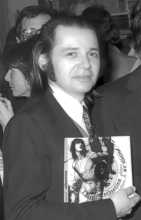
 The French artist Jacques Cortellari grew up in Rennes in Brittany, the eldest of four children of Alberto Cortellari – an Italian architecture student, naturalised after the war, who became one of the principal architects of the postwar reconstruction of Brest and the restorer of the manoir de Kéroual – and his Brestoise wife. Tuberculous meningitis at the age of four left Jacques hospitalised for an extended period at the Hôpital Trousseau in Paris, and in need of a long convalescence in the mountain sanatoria around Morzine in the French Alps. He was the only survivor on the infant ward, saved by the then-experimental use of penicillin, and the prognosis that he would not live past sixty would prove almost exact. Out of school until fourteen, he was taught to draw by his father, and was tutored privately, reading voraciously at night; he is said to have known Homer's Odyssey by heart.
He entered the École des Beaux-Arts in Paris at seventeen in the Section d'Or under Jean Souverbie and Roger Limouse, and also trained as a copper engraver. The Galerie Guigné in Paris represented him exclusively for many years; he also showed in Brest and New York, and in Norway, Germany and Japan. In 1968 he refused the Grand Prix de Rome, and in the 1980s declined to collect a prize for engraving awarded to him in Vienna, gestures consistent with what those who knew him recall as a stubborn perfectionism and a refusal of compromise. He settled at Kéroual, the manor his father had restored, with his second wife Marie-Thérèse Buquen and their son Kévin, and worked there until his death.
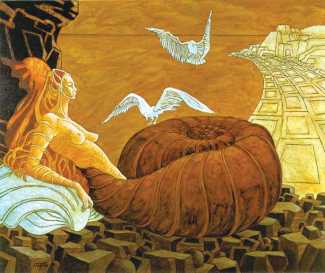
In 1980 his friend Laurent Boilet wrote of the Janus nature of Cortellari’s art – the Italian inheritance gave a sense of drama, theatre and frank colour, while the Breton inheritance offered secrecy, sombre states of mind, and the fascination with the sea and the unchanging landscape. He moved from a brief expressionist phase in the mid-1960s, through the work of the later 1960s and early 1970s, to the nature-inspired paintings of the late 1970s. His family’s tally of his estate credits him with around 800 paintings and 2,400 drawings and engravings, plus a number of frescoes. The 1969 Aglaé portfolio belongs to that drawing-and-engraving strand of the practice rather than standing apart from it; what makes it unusual among his work is not its technical or pictorial temperament, which is entirely consistent, but its erotic context, which appears nowhere else in his recorded output.
There is much more information about Jacques Cortellari at his family’s website, which you will find here.
Similar artists
Édouard Chimot – French art-deco illustrator of Pierre Louÿs and other erotic editions.
André Collot – French illustrator of bawdy contes drolatiques and erotic editions.
Serge Czerefkov – Russian-French émigré illustrator of Pierre Louÿs’s Aphrodite.
Georges Lepape – French art deco pochoir illustrator for the Gazette du Bon Ton.
Sylvain Sauvage – French art-deco illustrator of refined livre d’artiste editions.
Example illustration

Aglaé (1969)


