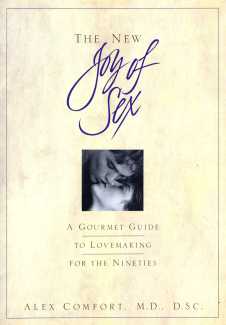
 The New Joy of Sex: A Gourmet Guide to Lovemaking for the Nineties by Alex Comfort is a substantially revised American edition of the famous 1972 manual The Joy of Sex, the book that arguably did more than any other single volume to domesticate the sexual revolution for middle class readers. Comfort, a British doctor and libertarian social thinker, conceived the work as a candid but humane guide for adults, written in plain language, and illustrated so that couples could understand sexual technique, communication and mutual pleasure without embarrassment. The 1972 edition became an international bestseller, notable for its explicit drawings by Charles Raymond (which you can see here), its culinary metaphors, and its emphasis on affection and reciprocity rather than conquest.
By 1991 social circumstances had changed dramatically. The AIDS crisis, shifting gender politics, and a more psychologically oriented view of relationships required substantial revision. The New Joy of Sex updates the text throughout – safer-sex practices are incorporated, casual promiscuity is treated more cautiously, and greater attention is given to emotional communication, consent and equality between partners. While it retains the structure of the original – anatomy, arousal, techniques, variations, and common difficulties – the tone is less carefree than the original version.
John Raynes became closely associated with late twentieth century sex manuals because publishers recognised from his figure drawing manuals that he could do something surprisingly rare – draw explicit material that still looked instructional rather than pornographic. His involvement with both The New Joy of Sex and The Good Sex Book belongs to a very particular publishing problem.
The original 1972 Joy of Sex had been illustrated by Charles Raymond, and by the late 1980s publishers wanted updated imagery. Photographic illustration had become common in continental European sex guides, but in Britain and the United States it posed distribution and censorship difficulties – photographs could trigger obscenity concerns in some retail channels and libraries, while drawings were culturally and legally easier to classify as educational. What was required was clarity without titillation, anatomical accuracy, instruction that was reassuring to a general readership.
Raynes already had the ideal background. His style – careful line, soft modelling, naturalistic but restrained body types, composed facial expressions – lent itself perfectly to what publishers needed. In The New Joy of Sex his figures are ordinary adults, albeit young, attractive and heterosexual, and the artistic poses are staged among rumpled sheets, emphasising position, comfort and communication. There is an artistic consistency of treatment with the limited colour palette and restrained line; the only downside being that many of the illustrations are printed across a double page spread, often breaking the drawing in awkward places.
The New Joy of Sex was published by Crown Publishers, New York.