But I, beloved Narcissus, am curious only about my very being;
everything else has nothing more than a heart of mystery,
everything else is nothing but absence.
Only what I own, my dear sovereign body, is what I have.
The most beautiful of mortals cannot cherish anything more than itself.
Sweet and golden, is there a more holy idol
within an entire forest, self-consumed and held
and set in the living azure by so many birds?
Is there a more divine gift than the favour of the waters
and a more adorable use of the dying day
than to return to me the honour of my face?

The French symbolist poet Paul Valéry (1871–1945) returned repeatedly to the figure of Narcissus across his career, producing three major poems: Narcisse parle (1891), Fragments du Narcisse (1926), and Cantate du Narcisse (1938). Together they chart not only a reinterpretation of the classical myth, but also the evolution of Valéry’s own poetics from symbolist reverie to austere intellectual music.
Narcisse parle, written in Valéry’s youth under the influence of Mallarmé, presents a solitary, introspective speaker entranced by his reflection. The myth becomes a meditation on consciousness contemplating itself. The pool is less a natural setting than a mirror of the mind; the drama unfolds internally, in a heightened, musical language dense with symbol. Narcissus is divided between desire and knowledge: he both longs for and analyses the image he loves. The poem already reveals Valéry’s lifelong preoccupation with the self as both subject and object of thought.
By the time of Fragments du Narcisse Valéry’s style was more crystalline and controlled. The poem breaks the myth into sculpted sections, almost philosophical études. Narcissus becomes an emblem of pure reflexivity, the mind fascinated by its own operations. The tone is cooler, the imagery more abstract; sensuality gives way to geometry and cadence. Finally, Cantate du Narcisse transforms the myth into something more theatrical and choral. Written for performance with music, it introduces multiple voices and a more dramatic structure. The solitary self of the early poem opens outward into a ritual meditation on beauty, illusion, and self-loss.
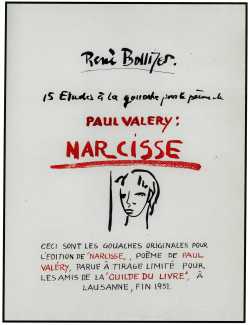 The Valéry Narcisse poems clearly had a profound effect on Bolliger, who produced this series of gouache studies on a black background for a limited edition of the poems for the Friends of Lausanne Book Guild.