
 René Bolliger occupies a distinctive place in the history of twentieth-century homoerotic art. He came of age between two world wars, and matured as an artist in a Europe that was at the same time culturally adventurous and morally censorious. His reputation developed quietly, largely outside official institutions, and for much of his life his work circulated in private rather than in the public sphere, yet within the intimate networks of collectors, writers and bibliophiles who sustained homoerotic literature and art, Bolliger was admired as a draughtsman of rare sensitivity and boldness.
Bolliger was Swiss by birth, born to a single mother in Lausanne. Until he was eight he lived with his grandparents, his grandfather Gustav Bolliger-Brunner being a sculptor, but after he went back to live with his mother in 1919 his life went downhill. He spent several years in reform schools, borstals, even a spell in prison for theft and fraud. Between 1934 and 1949 he was regularly admitted to the Friedmatt Psychiatric Clinic in Basle.
It was during this time that Bolliger awoke to art. In October 1938 he met a Basel art gallery owner, Margeurite Schulthess, and a year later exhibited in her gallery. With her support, he enrolled in the Basel School of Arts and Crafts, continued to show his work, and was commissioned to produce a series of illustrations for Verlaine’s Hombres.
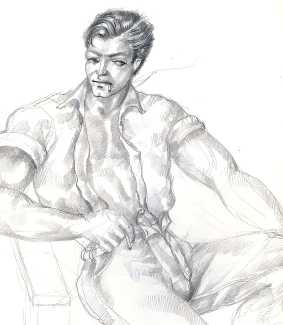
In September 1949 René Bolliger left Switzerland for Paris, with its magnetic pull on writers and artists seeking creative freedom and an appreciative audience, a haven for literary experiment and sexual dissidence. Bolliger found his milieu not in academies or official salons, but in the more discreet company of poets, novelists and publishers who understood the power and the risk of erotic imagery.
The subject that made his name was male homosexuality. In the 1940s, 50s and 60s, explicit visual representations of gay male desire could not circulate openly without risk of seizure or prosecution. Bolliger’s work therefore appeared in limited, often clandestine editions, intended for a circle of connoisseurs. This semi-hidden mode of dissemination profoundly shaped both his career and his legacy. He did not cultivate a conventional exhibition record; nor did galleries acquire his drawings in any systematic way. Instead his reputation passed from hand to hand, from collector to collector, through portfolios and privately printed books.
Among the writers whose texts he illustrated were figures central to modern French literature. He is associated with illustrated editions of works by Jean Cocteau and Jean Genet, as well as with texts by Paul Verlaine and Paul Valéry, his art being particularly suited to the morally ambiguous, erotically charged worlds conjured by these authors.

Because his career unfolded in a semi-clandestine world, details of his life in Paris are comparatively sparse. He did not cultivate celebrity, though he knew and spent time with like spirits including Jean Cocteau and Francis Carco. There is little evidence of engagement with the avant-garde movements that dominate conventional art histories of the period, yet this absence should not be mistaken for insignificance. Bolliger’s importance lies precisely in his participation in a parallel cultural stream – the private press, the illustrated erotic text, the exchange of drawings among a knowing few.
By the time of Bolliger’s death, in Frankfurt in Germany under ambiguous circumstances – he was described as homeless and it was thought that he might have killed himself – social attitudes toward homosexuality were beginning to shift. Sadly he did not live to see the more expansive public recognition of queer art that would develop in subsequent decades. His work remained largely in private hands, surfacing intermittently at auction or in specialist exhibitions devoted to erotic illustration. Only in recent years has there been a more concerted effort to place him squarely within the broader narrative of twentieth-century art and queer visual culture.
 Fortunately René Bolliger’s life and art have been lovingly and thoroughly documented in a lavish illustrated book, Les beaux mâles (The Handsome Studs), edited by Nicole Canet and published by Éditions Galerie au Bonheur du Jour, where you can see most of the Bolliger drawings included here plus many more. Les beaux mâles can be purchased from Éditions Galerie au Bonheur du Jour by following this link.
Similar artists
Neel Bate – American mid-century illustrator of homoerotic subjects.
Jean Boullet – French illustrator of male beauty in same Saint-Germain milieu.
Roland Caillaux – French illustrator of mid-century clandestine homoerotic subjects.
Jean Cocteau – French artist and writer of homoerotic drawings and literature.
Peter Flinsch – German-Canadian illustrator of mid-century homoerotic subjects.
Touko Laaksonen – Finnish illustrator of mid-century homoerotic subjects.
Example illustration


