 Jésus-la-Caille is the gritty, debut novel of French writer Francis Carco, first published in 1914 in the Mercure de France just months before World War I upended European society. With this book Carco staked his claim as chronicler of Paris’s underbelly – Montmartre and Belleville’s prostitutes, pimps, petty crooks and night-haunted streets – in a style that prefigures noir before Hammett or Chandler.
At its centre is Jésus-la-Caille himself, a handsome, effeminate young male sex worker and small-time pimp whose nickname (‘la caille’ literally means ‘quail’) signals both fragility and a slangy street caste. After his lover Bambou disappears into prison, Jésus is drawn into the orbit of Fernande, a female prostitute caught between competing pimps, the brutish Pépé-la-Vache and Dominique-le-Corse. Violence, betrayal, longing and doomed attraction propel the action through bars, shabby hotels and fog-lit corners where police prowl and gangsters vie for control.
The themes are unapologetically dark – marginalisation, the fatalism of characters unable to escape their milieu, and the collision of tenderness and brutality in a world of sex work and criminality. Carco neither sentimentalises nor moralises; his ear for Parisian argot and his unflinching depiction of homosexual and heterosexual prostitution were scandalous in 1914, even as the novel became a popular success.
The novel was translated into English in 1939 by Pierre Devaux, though extant translations, including a mid-century paperback, struggle with Carco’s dense argot, often substituting clinical terms for the original’s slang and losing much of its punch.
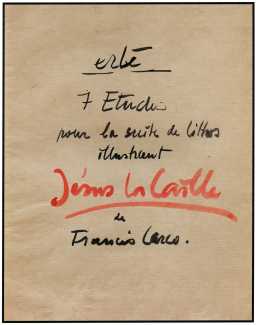
Carco’s novel clearly resonated with Bollinger, who probably identified with Jésus. Under the Erbé pseudonym he sometimes used, René Bollinger produced this series of lithographs depicting the novel’s main character displaying the tools of his trade.