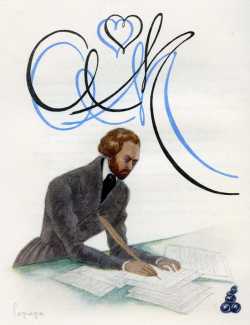
 The French dramatist, poet and novelist Alfred Louis Charles de Musset-Pathay (1810–1857) was one of the most prolific and widely-read authors of his time, comparable in many ways with Byron, Shelley, and even Charles Dickens. He was a central figure of the French romantic movement, his writing combining emotional intensity with elegant classical restraint. Born in Paris into a cultivated but relatively poor family, he achieved early success with his Contes d'Espagne et d'Italie (Stories of Spain and Italy, 1830) and became associated with leading literary circles of the July Monarchy.
His turbulent relationship with the novelist George Sand profoundly influenced his work, most notably La confession d'un enfant du siècle (Confession of a Child of the Century, 1836), a semi-autobiographical exploration of disillusionment and romantic suffering. Although many of his plays, including Lorenzaccio (1834), were not staged in his lifetime, they are now regarded as masterpieces of French drama. Elected to the Académie Française in 1852, Musset remains a key voice of nineteenth-century French literature, admired for his lyrical style and insight into the psychology of love and despair.
Musset matched the emotional register of the nineteenth century perfectly. His central preoccupations – passionate love, romantic betrayal, the anguish of the sensitive soul in a coarse world, the consolations and torments of alcohol and excess – were precisely what the bourgeois reading public wanted to feel vicariously. His verse has an immediacy and confessional warmth that felt like lived experience rather than literary performance.
The much-publicised affair Musset had with fellow author George Sand provided endless cultural fuel. Throughout the second half of the century the Sand–Musset liaison remained a subject of enormous public fascination, with memoirs, counter-memoirs and dramatisations. La confession d'un enfant du siècle was read as a roman à clef, which gave it a readership well beyond purely literary interest. Scandal and celebrity operated then much as they do now, and Musset was a celebrity author whose personal mythology kept his work in print.
Once Musset entered the school curriculum – and by the Third Republic he was firmly fixed in it – the demand for cheap, accessible collected editions meant that his work became part of every child's education. As late as the 1930s he remained a living presence in French cultural life, his plays regularly revived at the Comédie-Française, his verse still memorised by schoolchildren across the country.
But Alfred de Musset is barely read today. The confessional romantic lyric as a mode has lost its prestige, and what felt like depth and sincerity to a nineteenth-century reader now feels like self-pity dressed up as poetry. Musset has none of Baudelaire's structural irony, none of Rimbaud's formal violence, none of Verlaine's musicality.
There is also a gender dimension – much of Musset's appeal rested on a particular construction of wounded masculine sensibility, the enfant du siècle exhausted by history and betrayed by love. That figure commanded enormous sympathy for decades, but is no longer a model that most young men can identify with.
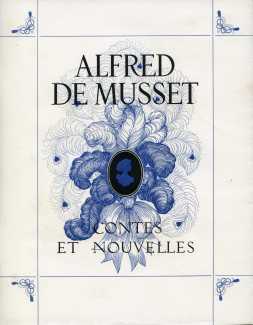 Inevitably, and again rather like Dickens in English, every major publisher wanted to produce a Musset complete works, and between 1866 and the late 1930s more than twenty Œuvres complètes had appeared, consisting of between ten and thirteen volumes. By the time Le Vasseur & Cie commissioned this edition in 1937, the illustrated collected works had become an established luxury format, the Librairie de France having introduced colour a decade earlier with its ten-volume Charles Martin edition of 1929. Le Vasseur's ambition was to surpass it. In a limited numbered edition, with the finest printed on Japon Impérial paper, this ten-volume edition engaged Georges Lepape – then at the absolute peak of his powers as the most sought-after decorative illustrator in Paris, equally at home on the covers of Vogue and in the ateliers of Poiret – to produce 144 full-page colour compositions engraved on copper. The result is a Musset for the age of art deco, sensuous, immaculately dressed, and lit with a chromatic brilliance that the earlier steel-engraved editions could never have imagined.
Lepape's treatment of Musset's more explicitly erotic writing is fascinating, a reflection on what was both acceptable and ‘artistic’ in the circles for which this luxury edition was intended. Naked women are plentiful, but the mode is theatrical rather than real-life. A recurring scenario is the watched encounter – a cloaked seducer pausing in the curtains, a red-robed figure with mask in hand standing over a swooning woman, a guitar-player serenading a sleeper from the night sky – placing the reader as accomplice rather than participant.
 The fashion illustrator's instinct asserts itself in regular states of undress – the half-laced corset, the rolled-down stocking, the chemise slipped from a shoulder, the mirror in which the back view becomes the front. When Lepape does become explicit – a woman astride a kneeling partner, a girl arched on a tufted chaise – the figures are stylised, elongated and decorative, set against opulent draperies of yellow, mauve, vermilion and pink, so that the explicitness remains contained by the design.
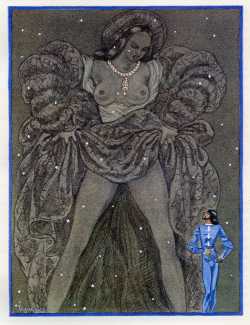
Stranger compositions are prompted, or perhaps released, by Musset’s imaginings – a disembodied coat hovers over an undressing courtesan, a colossal allegorical naked woman in starlit space dwarfs a tiny costumed admirer, a corpse-pale woman is watched over by a spectral androgyne in evening dress. Lepape’s eroticism reaches the reader through masquerade, dream, and a faintly surrealist disquiet that places these plates as much in the inter-war Paris of their making as in Musset's romantic 1830s.
The Lepape-illustrated Œuvres complètes de Alfred de Musset was published by Le Vasseur, Paris, in a limited, numbered and boxed edition of 2,820 copies. The set of ten volumes included La confession d’un enfant du siècle and two volumes of Contes et nouvelles, two volumes of poetry (Premières poésies and Poésies nouvelles), three volumes of Comédies et proverbes, Mélanges de littérature et de critique, and Œuvres posthumes. Of the 2,820 copies, 69 included an extra set of plates in colour and monochrome, and a further 271 included just the monochrome plates.