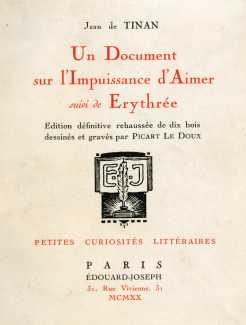
 Jean de Tinan (1874–1898) was one of the most gifted and short-lived writers of his Parisian generation, a friend of Pierre Louÿs and Henri de Régnier, a fixture of the young circle around the Mercure de France review, dead at twenty-four. Un document sur l'impuissance d'aimer (A Document about the Inability to Love), his first book, appeared in 1894 when Tinan was just twenty. Despite the title, the inability it describes has nothing to do with sex; it is the inability to love at all, the predicament of a young man who finds that desire, tenderness, and the recognition of a kindred mind never seem to settle on the same woman at the same time. The narrator presents this as a kind of clinical confession, hence the cool, scientific word 'document'. The prose is fragmentary, diary-like, and shot through with the self-deprecating irony of a young dandy who half-suspects his sufferings are a fashion as much as a fate. That mixture of genuine melancholy and unsparing self-awareness gives the book its strange charm – it diagnoses an entire generation’s romantic malaise without ever quite taking itself solemnly.
The first edition was a small printing of 310 copies issued by the Librairie de l'Art Indépendant, with an etched frontispiece by Félicien Rops and a slip of printed music after the title, a handsome and now scarce little book. Erythrée is in fact a separate work, first published in 1896 by the Mercure de France with illustrations by Maurice Delcourt, in which an old storyteller called Phéidas spins out, across seven short prose 'amphorae', the tale of his love for a warrior-queen – a lighter and more ornamental piece, closer in spirit to a sequence of prose poems than to the confessional Document. The two were paired for this edition by the publisher Édouard-Joseph as Un document sur l'impuissance d'aimer suivi de Erythrée, illustrated with ten woodcuts by Picart Le Doux.
Le Doux's ten illustrations were both drawn and cut by himself, then printed in a single olive-gold ink whose warm, slightly tarnished tone gives their antique flavour. The style is characteristic of the French woodcut revival that flourished after the first world war, with bold flat shapes, heavy outlines, and a deliberate stiffness in the figures, the contours often thickened by jagged hatching that catches the light of the page.
It is striking how cleanly the plates follow the narrative. The Document, Tinan's modern confession of romantic incapacity, is illustrated by contemporary subjects like the young woman in a wide-brimmed hat who could have walked out of any Paris park in 1920. Erythrée, the antique tale that follows, takes the imagery firmly backwards in time – the warrior-queen, reclining women with mirrors and amphorae, a temple between cypresses, a Mediterranean village with a broken colonnade.
Un document sur l'impuissance d'aimer suivi de Erythrée was published by Édouard-Joseph, Paris, in a limited numbered edition of 1,000 copies.