
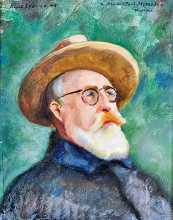
 Charles Alexandre Picart Le Doux was a distinctly individual figure in twentieth-century French art, a painter, engraver, illustrator and writer whose career unfolded between the bohemian vitality of pre-war Montmartre and the disillusionment of two world wars. Born into a Parisian family of artisans – his grandfather was a glass painter responsible for the south rose window of Notre-Dame – he was introduced early to drawing, but found academic training at the École des Beaux-Arts uninspiring. Instead, he educated himself in galleries, discovering the impressionists and concluding that painting must be the true expression of life.
In Montmartre he immersed himself in a remarkable artistic circle. He befriended figures such as Suzanne Valadon and Maurice Utrillo, and moved among writers and painters including Max Jacob, Pierre Mac Orlan, Henri Matisse and Pablo Picasso. He gravitated toward the Abbaye de Créteil group around Jules Romains, whose idealistic vision of art and community left a lasting mark. These years were lively, collaborative, and often whimsical, epitomised by his participation in the 1913 mock coronation of the eccentric thinker Jean-Pierre Brisset.
The first world war abruptly ended this world. A committed pacifist, Picart Le Doux greeted the outbreak with disgust at the fervour it inspired. Drafted as a medic, he spent four years confronting the brutality of the front, often tending the dying. The experience haunted him, the trauma deepening the emotional register of his later work and writing – ‘they failed to take my life, but they killed my soul and bruised my heart forever.’
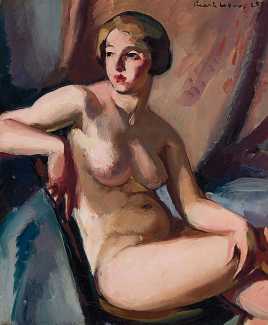
After the war he resumed painting and became known particularly for his paintings of naked women, praised for their direct and dazzling frankness. Critics noted his fidelity to a classical sense of the human figure, even as artistic fashions shifted. He refused to follow trends or bind himself to a dealer, a principled independence that limited his wider success. Alongside painting, he built a long career as an illustrator and teacher, influencing students at the Académie de la Grande Chaumière and the Académie Colarossi.
His personal life was marked by strong attachments. From his first marriage in 1900 to Angèle Souchay, he had two sons, Jean Picart Le Doux, later a celebrated tapestry designer whose fame eclipsed his father’s, and Yves, who also became a painter. They divorced in 1916 while Charles was on active war service. With his second wife, Marcelle, ‘a colourful woman brimming with vitality’ who he married in 1920, and their daughter Jacqueline, he formed a close-knit family affectionately known as ‘Les trois Pic’.
The approach of the second world war filled him with dread, and he spent the occupation years in relative refuge in Touraine. After 1945, though honoured with a major publication and the Legion of Honour, he expressed a sombre view of modern life as spiritually diminished, yet he tempered this with compassion, writing ‘Men deserved pity, my duty was to give them my tenderness.’
In his later years he turned increasingly to writing, producing memoirs and poetry, leaving a legacy of an artist of integrity, independent, humane, and quietly resistant to fashion.
Similar artists
Jean-Gabriel Daragnès – French engraver, printer and illustrator of modernist fine editions.
André Dignimont – French interwar illustrator of Parisian low-life and erotic subjects.
Chas Laborde – French modernist illustrator and caricaturist of Parisian life.
Mariette Lydis – Austrian-French School-of-Paris painter of refined erotic subjects.
Suzanne Valadon – French painter of unguarded naked bodies in the Montmartre circle.
Kees van Dongen – Dutch-French Fauvist painter of the School of Paris.
Marcel Vertès – Hungarian-French illustrator of fashionable Parisian and amorous subjects.
Example illustration


