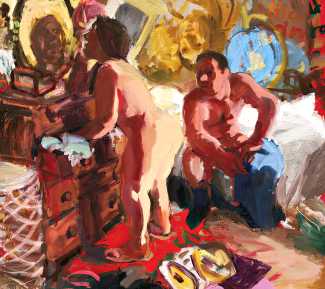
There is a good case to be made that Wendy Sharpe is, in a very real sense, an erotic artist. That might sound surprising, given that she is one of Australia’s most decorated painters – an Archibald Prize winner, an official war artist, a figure celebrated in major galleries, certainly not someone you would find tucked away in the adult art section. But when we look at what she paints, how she paints it, and the way she stages herself and her subjects, eroticism runs through the core of her work.
Sharpe has always been fascinated by the human body, not just as anatomy, but as something alive, performative, expressive and sensual. She paints people in intimate moments, dancers on the edge of performance, lovers in embrace, or herself in the studio surrounded by the charged atmosphere of looking and being looked at. Even when the subject is not explicitly erotic there is a lush, unapologetic physicality.
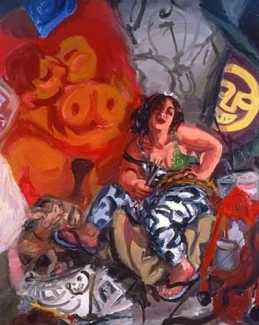
One of the best examples is her Self-Portrait as Diana of Erskineville (1996), the work that won her the Archibald Prize. In it, she stares straight at the viewer, hands on hips, wearing animal-print leggings and a green bra, equal parts goddess, neighbour and unapologetic exhibitionist. It’s funny and bold, but also genuinely erotic, a woman painting herself as both subject and object, at the same time fantasy and author of the fantasy. There’s no male gaze here; she owns the whole spectacle.
Sharpe’s eroticism is not limited to self-portraits. Over the years she has painted burlesque performers, mythological goddesses, lovers, cupids, all with a playful theatricality. She is fascinated by the idea of performance, by how people present their bodies, how costume, gesture and lighting can turn an ordinary person into a fantasy. Her work often feels like the visual equivalent of cabaret – expressive, knowingly seductive, but always aware of the line between artifice and authenticity.
What keeps her art from being titillation is how self-aware it is. Sharpe paints the naked body not as a static object of desire; her figures move, perform, think, flirt – they have agency. Even in her most mythic or imaginary scenes there is a sense that she is exploring the psychology of the erotic, how fantasy works, how desire is staged, how identity shifts when we step into a role.
While Wendy Sharpe might not fit the cliché of an erotic artist in the narrow sense, her art is unmistakably erotic in both subject matter and spirit. In Sharpe’s world the erotic is a way of understanding real life – messy, theatrical, full of colour and feeling.
The paintings are shown here in roughly chronological order, from her student work to recent canvases.