The works in this portfolio span four decades, from the emergence of Delvaux’s mature style in the late 1930s to the meditative paintings of the 1970s. Together they reveal the remarkable consistency of his artistic vision. Familiar motifs recur throughout – mirrors, temples, trains, forests, ruins, skeletons and, above all, the female figure. Delvaux continually rearranged these elements into new psychological landscapes.
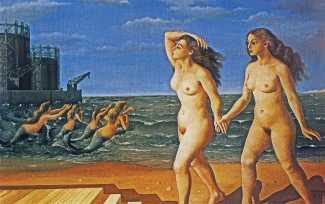
Naked women have a central place in his art, although not in the conventional tradition of the reclining Venus or academic life study. Delvaux’s women appear as enigmatic presences rather than narrative characters. They rarely acknowledge the viewer, remaining absorbed in their own thoughts or in silent relationships with one another. Any suggestion of desire is created through atmosphere rather than action, inviting prolonged looking rather than any immediate response.
Architecture plays an important role – classical buildings, Roman ruins and Greek temples evoke an idealised antiquity, while stations, tramlines and railway tracks introduce a distinctly modern vocabulary. Delvaux delighted in placing these contrasting worlds together, allowing ancient myths and contemporary life to coexist within the same impossible landscape. Paintings like Birth of Venus, Leda, Acropolis, Pompei, and The Visit to Ephesus reveal how naturally mythology became part of his visual language.
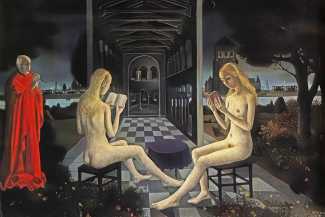
Several of Delvaux’s most celebrated themes are represented here. The Courtesans, Woman with Mirror, The Two Friends and In Praise of Melancholy show his fascination with what he perceived as the mysterious psychology of the female figure. Night Train, The Beautiful Night and Silent Night demonstrate his lifelong affection for railways and nocturnal cityscapes, while The Sabbath, Dialogue and Sirens are part of the exploration of dream, ritual and myth during the later decades of his career.
Although often grouped with the surrealists, Delvaux followed a highly individual path. Unlike Salvador Dalí’s extravagant fantasies or René Magritte’s philosophical paradoxes, his paintings create imaginary places that seem entirely believable on their own terms. His women inhabit timeless cities, landscapes of moonlit squares, deserted platforms, marble colonnades, and quiet streets where time is suspended. Over four decades Delvaux succeeded in transforming his vision of the naked woman into one of the defining symbolic figures of modern art, playing their essential part in images that are at once sensual, poetic – and profoundly mysterious.