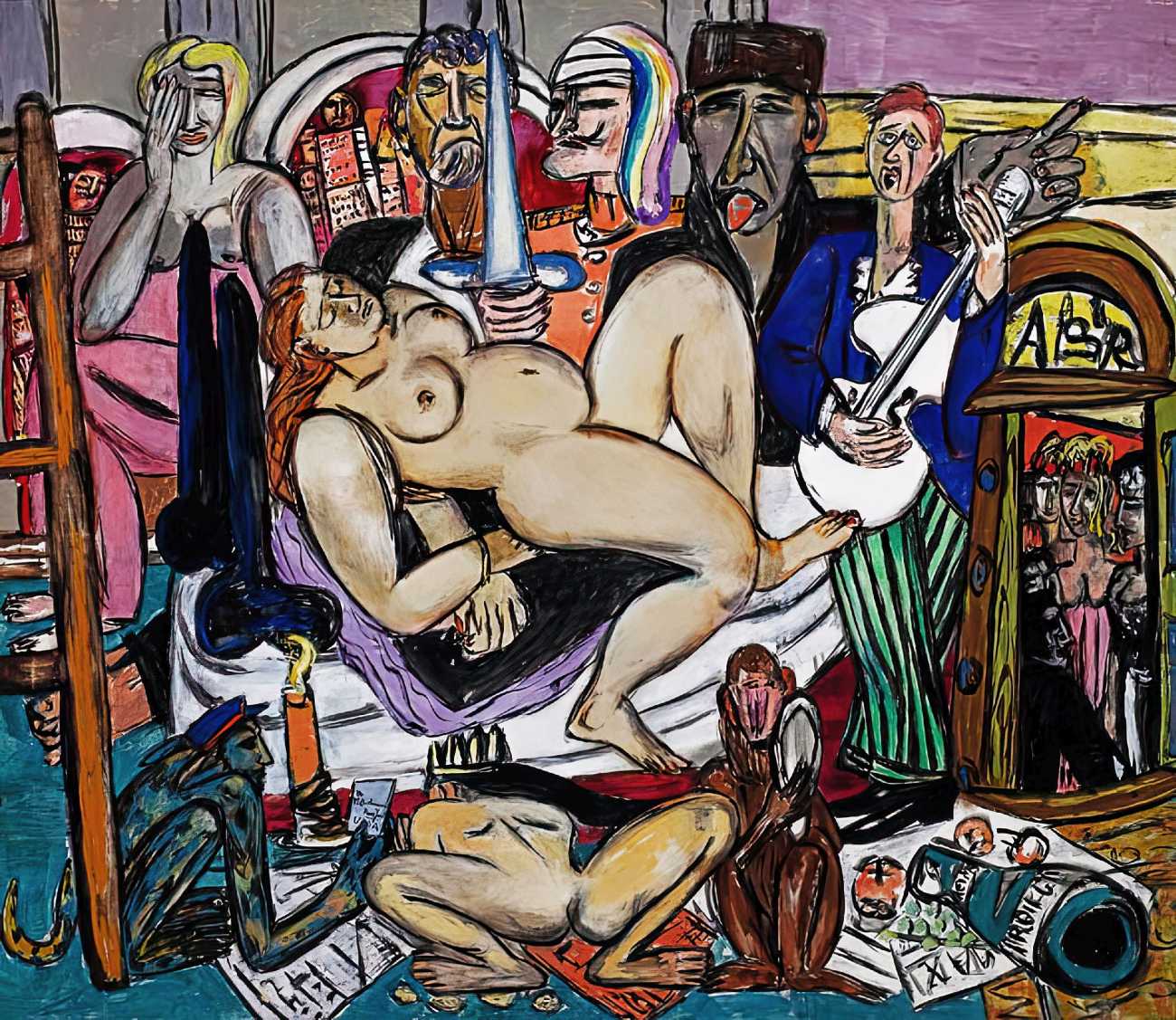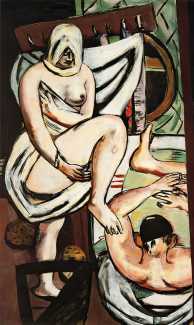
Beckmann's paintings teem with bodies, pressed together, tangled, bound, displayed. Even in ostensibly light-hearted subjects, the erotic charge is rarely far from the surface. His circus and carnival pictures of the 1920s, such as the various depictions of acrobats, trapeze artists and female performers, present the body as spectacle, costumed and contorted. The gaze in Beckmann is never comfortable or innocent; there is always something coercive and uneasy.
The great triptychs he painted during his Amsterdam exile – Acrobats (1939), The Actors (1941–42), and Blind Man's Buff (1945) – make this erotic-political entanglement explicit. In these densely populated works, figures are tied, caged, blinded and paraded. The bound woman is a recurring presence, not so much as an explicitly erotic element but more a symbolic one. Naked women are a constant throughout Beckmann’s career, and they are rarely passive. His women gaze back at the viewer, less objects of contemplation than facts of flesh that refuse to be aestheticised.
Beckmann’s paintings are shown here in chronological order, from his student work of 1905–6 to his final New York paintings.