
 Although he is usually classified as an expressionist artist, the German painter, draughtsman, printmaker, sculptor and writer Max Carl Friedrich Beckmann rejected both the term and the movement. In the 1920s he was associated with the New Objectivity (Neue Sachlichkeit), an outgrowth of expressionism that opposed its introverted emotionalism. Even when dealing with light subject matter like circus performers, Beckmann often had an undercurrent of moodiness or unease in his works. Through the 1930s, as Nazism took hold, his work became more explicit in its horrifying imagery and distorted forms, a combination of brutal realism and social criticism.
Beckmann was born into a middle-class family in Leipzig, and completed his formal artistic training at the Grand-Ducal Art School (Grossherzogliche Kunstschule) in Weimar in 1903. He had enrolled at the academy at the age of sixteen, studying primarily under the Norwegian realist painter Carl Frithjof Smith. Beckmann’s traumatic experiences of the first world war, in which he volunteered as a medical orderly, coincided with a dramatic transformation of his style from academically correct depictions to a distortion of both subject and space, reflecting his altered vision of himself and humanity. Well-read in philosophy and literature, Beckmann studied mysticism and theosophy, striving to find the spiritual dimension in his subjects.
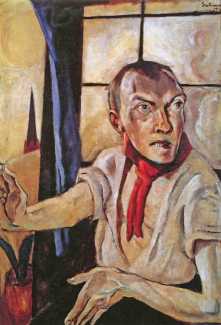
The Weimar years were good to Beckmann, bringing both commercial success and the recognition of the German art establishment. In 1925 he was appointed to lead a master class at the Städelschule in Frankfurt, where his pupils included Theo Garve, Leo Maillet and Marie-Louise von Motesiczky. Official honours followed – the Honorary Empire Prize for German Art and the Gold Medal of the City of Düsseldorf in 1927, and at the turn of the decade a run of substantial retrospectives, among them the Städtische Kunsthalle Mannheim in 1928 and exhibitions in Basel and Zurich in 1930.
Hitler’s accession to power changed all of this. The regime’s contempt for modern art translated quickly into state suppression, and Beckmann was an early casualty. In 1933 he was branded ‘a cultural Bolshevik’ and stripped of his teaching post in Frankfurt. In 1937 more than five hundred of his works were seized from German museums, a number of them paraded in the notorious Degenerate Art exhibition in Munich. The day after Hitler’s radio broadcast denouncing degenerate art, Beckmann and his second wife, Quappi, left Germany for the Netherlands.
The exile that followed lasted a decade. Settled in Amsterdam, and repeatedly thwarted in his efforts to obtain a visa for the United States, Beckmann remained effectively trapped. In 1944 the occupying authorities even attempted to conscript him, a man of sixty who had already suffered a heart attack. Far from diminishing his work, the Amsterdam studio produced some of his fiercest and most concentrated painting, more intense than anything from the Frankfurt years, including several of the large triptychs.
A way out came only in 1947, when he accepted a post at the Art School of Washington University in Saint Louis, where the German-American painter and printmaker Werner Drewes was among his colleagues. The following year the City Art Museum in Saint Louis mounted his first American retrospective; it was there that Morton D. May, the department-store magnate, became his patron and collector, and later gave much of his extensive Beckmann holdings to the Saint Louis Art Museum. In 1949 Beckmann moved to New York to take up a professorship at the Brooklyn Museum Art School, the last of his appointments. He and Quappi took an apartment at 38 West 69th Street in Manhattan, and it was near there, at the corner of 69th Street and Central Park West, that Beckmann was struck down by a heart attack just after Christmas 1950, on his way to see one of his paintings at the Metropolitan Museum of Art.
Beckmann's output was vast – over eight hundred paintings, as well as hundreds of prints, drawings and sculptures. He also wrote prolifically, diaries, essays, plays and letters, engaging with Schopenhauer, Nietzsche, Dostoyevsky, and the traditions of western mysticism.
Similar artists
George Grosz – fellow New Objectivity satirist of Weimar Berlin.
Egon Schiele – German expressionist contemporary.
Rudolf Schlichter – New Objectivity painter of fetishistic, erotic subjects.
Georg Scholz – Verist whose savage social satire shares Beckmann's cold eye.
Otto Rudolf Schatz – Viennese New Objectivity printmaker of nightlife, jazz and the erotic demi-monde.
Curt Grosspietsch – Dresden Verist who was drawn to the grotesque and the uncanny.
Example illustration


