
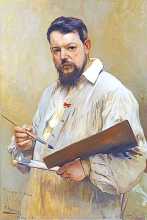
 Few painters have made light itself their subject as completely as the Spanish painter Joaquín Sorolla. Born and bred in Valencia, he spent his career chasing the particular quality of Mediterranean sun and its effect on moving water, on wet sand, on the skin of children running into the sea, and in doing so created a body of work so vivid and immediate that it seems less painted than captured. His reputation, enormous in his lifetime, faded somewhat after his death as the art world moved elsewhere, but it has never disappeared; his paintings are simply too pleasurable to ignore for long.
Sorolla grew up in Valencia, the eldest child of a tradesman, also named Joaquin Sorolla, and his wife, Concepción Bastida. In August 1865 he and his younger sister Concha were orphaned when both their parents died from cholera, after which they were cared for by their maternal aunt and uncle. Joaquin received his first art education when he was just nine years old, and continued under a succession of teachers including Cayetano Capuz and Salustiano Asenjo. At the age of eighteen he travelled to Madrid, studying master paintings in the Museo del Prado. After completing his military service, when he was twenty-two, he obtained a grant which enabled a four-year term to study painting in Rome, where he was welcomed by Francisco Pradilla, the director of the Spanish Academy in Rome. A long sojourn to Paris in 1885 provided his first exposure to modern painting; especially influential were exhibitions of Jules Bastien-Lepage and Adolf von Menzel. Back in Rome he studied with José Benlliure, Emilio Sala and José Villegas Cordero.
In 1888 Sorolla returned to Valencia to marry Clotilde García del Castillo, who he had first met in 1879 while working in her father’s studio. By 1895 they had three children, Maria in 1890, Joaquín in 1892, and Elena in 1895. In 1890 the family moved to Madrid, and for the next decade Sorolla’s efforts as an artist were focused on the production of large canvases of orientalist, mythological, historical and social subjects for display in salons and international exhibitions in Madrid, Paris, Venice, Munich, Berlin and Chicago.
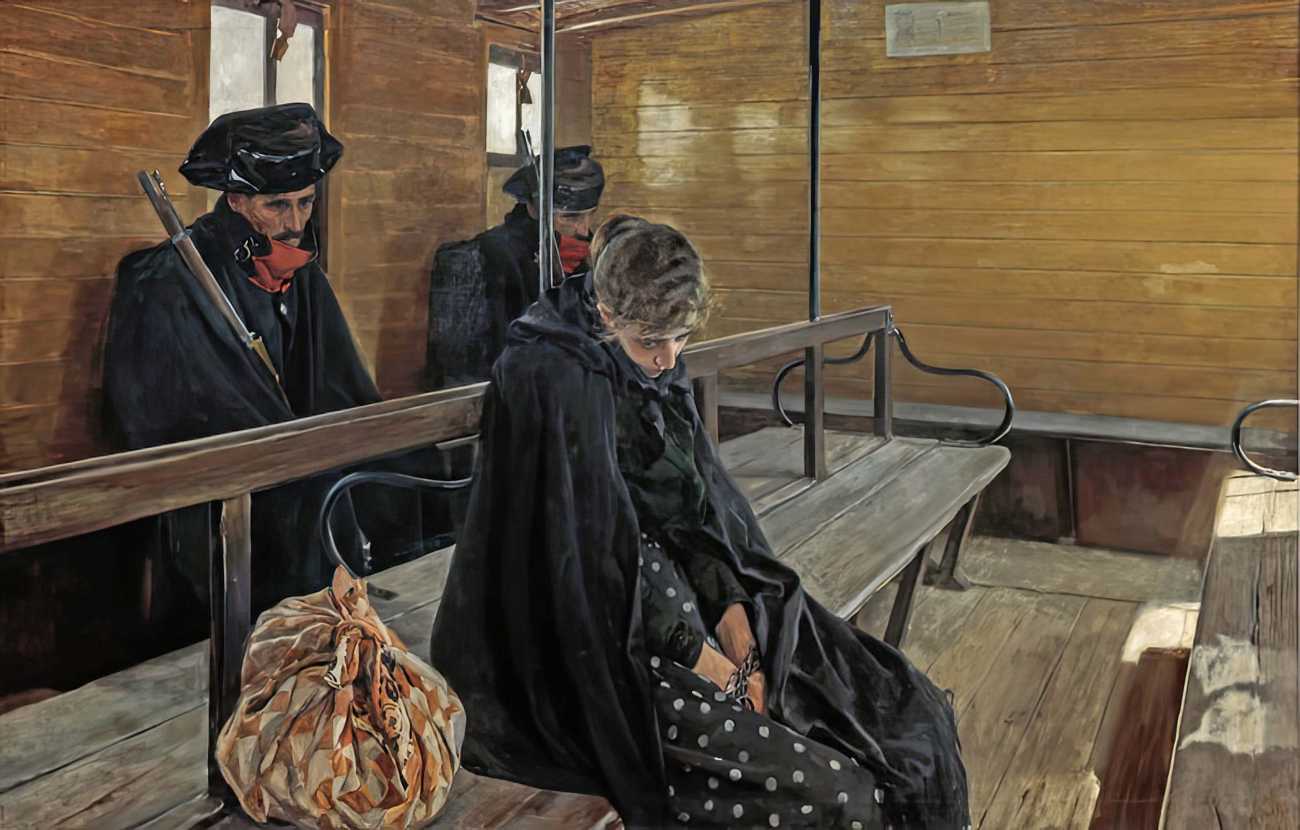
His first striking success was achieved in 1892 with ¡Otra Margarita! (Another Marguerite!), which was awarded a gold medal at the National Exhibition in Madrid, then first prize at the Chicago International Exhibition, where it was acquired and subsequently donated to the Washington University Museum in St Louis, Missouri.
He quickly became the acknowledged master of the modern Spanish school of painting. His exhibit at the Paris Universal Exposition of 1900 won him a medal of honour and his nomination as Knight of the Legion of Honour, and within the next few years Sorolla was honoured as a member of the Académie des Beaux-Arts in Paris, The National Academy of Fine Arts in Lisbon, and the Real Academia de Bellas Artes de San Carlos de Valencia.
A special exhibition of his works at the Galeries Georges Petit in Paris in 1906 eclipsed his earlier successes, including nearly five hundred works, from early paintings to recent sun-drenched beach scenes, landscapes and portraits, a productivity which amazed critics and was a financial triumph. Subsequent large exhibitions in Germany and London were greeted with more restraint. While in England in 1908 Sorolla met Archer Milton Huntington, who made him a member of the Hispanic Society of America in New York City, and invited him to exhibit there in 1909; the exhibition comprised 356 paintings, 195 of which sold. Sorolla spent five months in America, and painted more than twenty portraits.
Sorolla's influence on other Spanish painters, including Alberto Pla y Rubio and Julio Romero de Torres, was so significant that they are often described as ‘sorollista’. After his death Sorolla’s widow, Clotilde García del Castillo, left many of his paintings to the Spanish public, in 1932 forming the collection that is now known as the Museo Sorolla in the artist’s house in Madrid.
Similar artists
Edgar Degas – French painter and printmaker of brothel and intimate subjects.
Albert Marquet – French Fauvist painter who also made intimate erotic drawings.
Jules Pascin – Bulgarian-French painter of Parisian erotic and bohemian subjects.
Eusebi Planas – Catalan nineteenth-century illustrator of romantic, erotic subjects.
Suzanne Valadon – French painter of unguarded naked bodies of the same generation.
Félix Vallotton – Swiss-French painter and woodblock printmaker of erotic subjects.
Anders Zorn – Swedish painter and etcher of sensuous naked bathers.
Example illustration


