
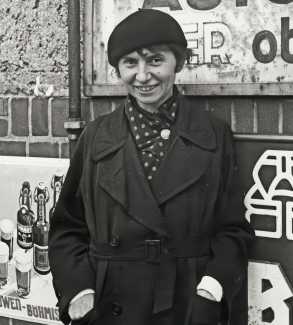
 Jeanne Mammen was one of the most distinctive chroniclers of the German Weimar Republic, distinguished by her sharp artistic social commentary and mastery of graphic technique. While her male contemporaries like George Grosz and Otto Dix viewed Berlin’s bustling interwar metropolis with cynical detachment or grotesque exaggeration, Mammen approached her subjects with an honest and engaged intimacy. Her work stands as an important record of an all-too-short era of social liberation, capturing both the dazzling heights and the seamy underbelly of a city on the edge of a political precipice.
Mammen was raised in a wealthy, liberal merchant family, which allowed her and her sister and fellow artist Mimi to enjoy a progressive education. Though born in Berlin, the family moved to Paris when she was five years old. Jeanne began her formal studies at the prestigious Académie Julian from 1906 to 1908, where she was heavily influenced by French literature, symbolism, and the works of Edgar Degas and Henri de Toulouse-Lautrec. From Paris she moved to Brussels, to continue her education for three years at the Royal Academy of Fine Arts. Here her early work shifted toward art nouveau and the decadent movement. A year in Rome at the Scuola Libera Accademia gave her a taste of classic art before returning to Paris. In 1920 Jeanne and Mimi jointly rented a small two-room studio in Berlin at Kurfürstendamm 29, a bohemian space they shared for several years while collaborating on commercial art, fashion illustrations and film posters.
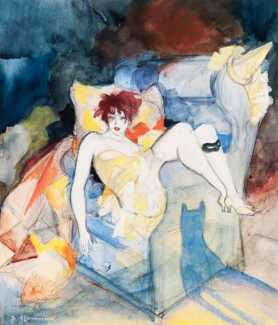
The subject for which Mammen’s art is best known is its depiction of the neue Frau, the financially independent, short-haired, cigarette-smoking woman who emerged in the 1920s. She embedded herself in the shadowy nightlife of Berlin, her work offering an unparalleled perspective on the era’s lesbian bars, trans-inclusive dance halls and crowded cafes alongside the grim realities of economic depression, portraying impoverished citizens with honesty and dignity. In her 1931 illustrations for Curt Moreck’s Führer durch das ‘lasterhafte’ Berlin (Guide to ‘Depraved’ Berlin) she documented the city’s notorious nightlife not to exploit or condemn it, but to document its authentic reality.
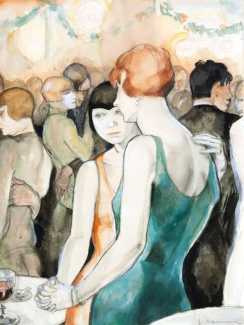
Having trained formally, Mammen possessed a strong command of line and form. Her primary mediums during the Weimar years were watercolour, pen and ink, and lithography. She developed a style characterised by sharp elegant contours filled with delicate, translucent washes of colour. This contrast between the precise line and the atmospheric watercolour mirrored the tension of Berlin itself. Mammen frequently created tight compositions forcing the viewer into claustrophobic proximity with her subjects.
When the Nazi regime seized power in 1933 it condemned her realistic, queer-inclusive subject matter as ‘degenerate’. Refusing to flee Germany, Mammen entered a period of ‘inner emigration’. Stripped of her ability to publish illustrations, she abandoned her signature delicate watercolours and sharp social realism, turning to bold, heavily textured oils and fragmented, cubist-inspired abstraction. Her palette darkened, and she began incorporating found materials like wire, string and tinfoil into her paintings, transforming her art into a private, defiant act of resistance against totalitarian conformity.
Similar artists
Édouard Chimot – French illustrator and editor of refined erotic livre d’artiste editions.
Edgar Degas – French painter and printmaker of brothel and intimate subjects.
George Grosz – German Weimar painter and graphic artist of biting figurative content.
Mariette Lydis – Austrian-French painter of sensual, melancholic women.
Rudolf Schlichter – German Weimar painter of the Berlin demimonde and fetishism.
Marcel Vertès – Hungarian-French illustrator of fashionable Parisian and amorous subjects.
Gerda Wegener – Danish art-deco painter of elegant, explicit erotica.
Example illustration

Les chansons de Bilitis (1932)


