
 Richard Larter was one of Australia’s most distinctive painters, combining the visual language of pop art with an unembarrassed celebration of sexuality and a relentless critique of political and social hypocrisy. Although often described as an Australian pop artist, his work ranged far beyond pop, encompassing abstraction, portraiture, performance, film, and some of the most uncompromising erotic artworks produced in the second half of the twentieth century.
Larter grew up in Hornchurch in Essex, England, studied art as a teenager, was conscripted into the British army for a short period, and travelled to Europe and North Africa to study art and culture first-hand. As a trainee marine surveyor in the early 1950s Larter met Patricia Holmes, and they were married in 1953. In 1962 they and their young family emigrated to Australia, where the country’s expansive landscape, brilliant light and comparatively open artistic climate transformed his work. Settling first at Luddenham near Sydney and later at Yass in rural New South Wales, he developed a visual language unlike that of any of his contemporaries.
Larter constantly experimented with technique. His early paintings were made using hypodermic syringes filled with paint, allowing him to create intricate networks of coloured lines across the surface. Later he incorporated rollers, house-painting tools, glitter, collage and screen-printed imagery, freely mixing abstraction with figuration. News photographs, advertising, pornography, political leaders, celebrities and domestic life all became material for densely layered compositions that challenged conventional distinctions between high and low culture.
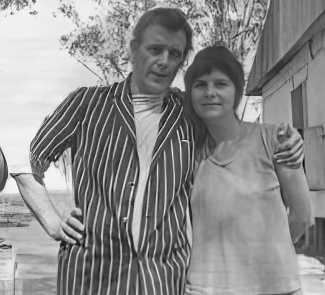
Central to both his life and his art was his partnership with Pat Larter (1936–96). More than simply his favourite model, she was an artist, filmmaker and pioneering performance artist whose feminist performances and satirical personae profoundly shaped Richard’s imagery. Their marriage was shaped by ideas of equality inspired by Simone de Beauvoir, and the dialogue between their respective practices continued for decades. Pat appears repeatedly throughout Richard’s paintings, not simply as a muse but as a collaborator, performer and political counterpoint.
Larter’s erotic paintings remain among his most controversial achievements. Rejecting idealised academic nudes and the coyness of mainstream glamour photography, he painted women with directness and candour, insisting that sexuality should neither be disguised behind mythology nor sanitised for polite consumption. For Larter, explicitness was less an act of provocation than one of honesty, an affirmation of pleasure, mutual desire and the reality of the body. His admiration for artists such as Egon Schiele and Gustav Klimt reflected this belief that erotic art could be both aesthetically ambitious and psychologically truthful.
Over a career spanning more than fifty years Larter exhibited extensively throughout Australia, culminating in a major retrospective at the National Gallery of Australia in 2008. Today his work is represented in all Australia’s principal public collections and is recognised as one of the country’s most original contributions to pop art, erotic art and contemporary figurative painting.
Richard Larter in his own words
Extracts from Joanna Mendelssohn, ‘The Stripper Rather Than the Teased: Richard Larter and Eroticism’, in Eroticism: Images of Sexuality in Australian Art (Craftsman House, 1992).
Richard Larter rarely softened his opinions, believing that erotic art should be direct, honest and free from the euphemisms that had long surrounded the nude. As he observed, ‘People have always said this funny thing, that they were not really looking at sex, but at Danae in a shower of gold or some noble mythological subject, but looking is looking.’ For Larter the problem lay not with sexuality itself but with a society that accepted violence more readily than the body – ‘It’s okay to thump your wife, but disgusting to look at her vulva.’
He regarded his art as a challenge to that hypocrisy: ‘Nudity and sexuality is something that still frightens society. We are barbarians, and by presenting full-frontal nudity with sexual organs showing, you’re challenging this idiot society we live in. The only way you deal with it is to be confrontational.’
His wife, the artist and performer Pat Larter, was central to his work, not simply as a model but as an artistic collaborator: ‘You’ve got to have an interaction between the model and the painter, and the only person I could be assured of is Pat. You peel away at Pat for ever and there will still be little bits to still discover and still be interesting.’
Larter was equally frank about the role of eroticism in his paintings, refusing to disguise either his intentions or those of his models. ‘In all honesty I am in the position of arranging for contrived voyeuristic poses, but being erotic doesn’t worry me. People who are actually in the sex industry are much more aware of what they’re doing. No one is under any illusion. And I like the idea of flirting with danger. I like the idea of being very close to kitsch, and I like experimenting. It’s only by failure that you learn.’
Similar artists
Eric Fischl – American painter of unflinching, confrontational sexual subject matter.
Gustav Klimt – Austrian symbolist, named as an important influence.
Claes Oldenburg – Swedish-American pop artist blurring high and low culture.
Jenny Saville – British painter who refuses to idealise or prettify the body.
Egon Schiele – Austrian expressionist Larter names as an influence.
Andy Warhol – American pop artist using appropriated imagery.
Example illustration


